
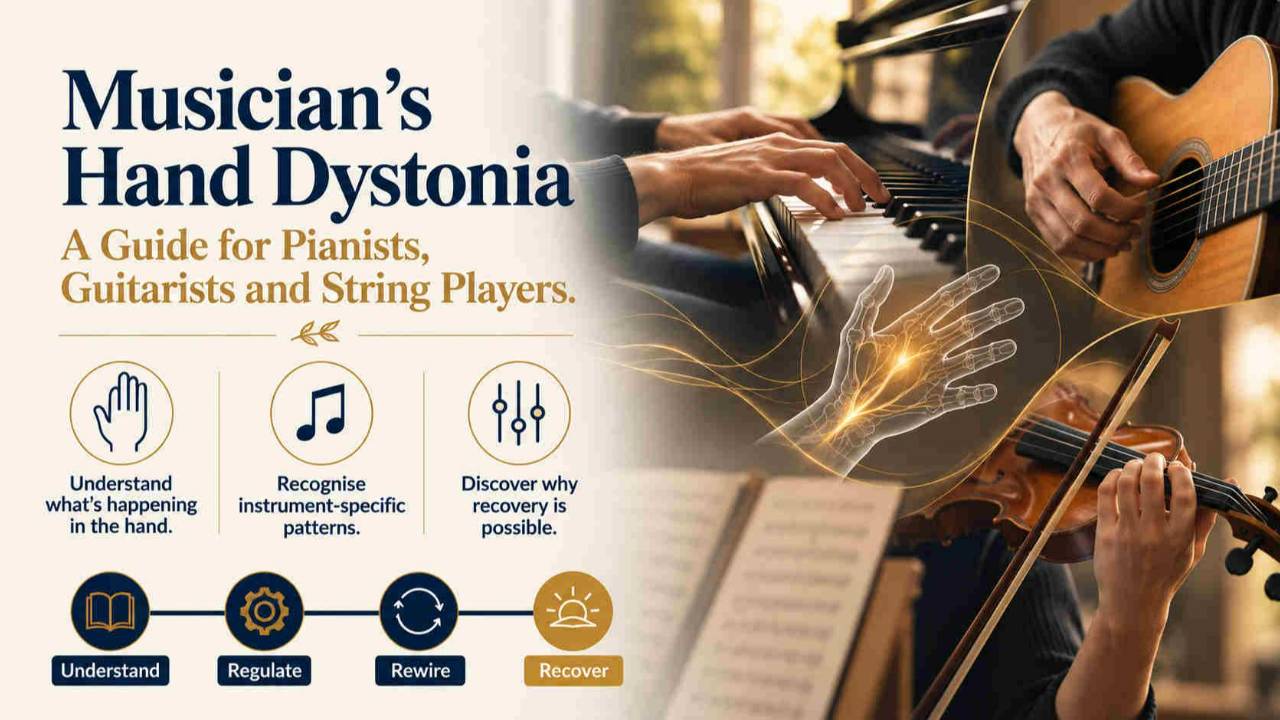
Musician's Hand Dystonia: A Guide for Pianists, Guitarists and String Players
Sep 10, 2026The hand that stops answering
For a pianist, a guitarist or a string player, the hand is not a tool. It is where years of listening and refining have been laid down — thousands of hours of them, until the movement no longer needs to be thought about at all. Which is precisely why it is so disorientating when the hand begins, quietly and only at the instrument, to stop answering.
A fourth finger that curls under in a run and will not lift. A bow hand that tightens in the lower half. A thumb that rises off the neck of the guitar without being asked. And the cruellest detail of all: away from the instrument, the same hand types, cooks and ties shoelaces without the least difficulty.
This is musician's hand dystonia, the most common form of focal dystonia in instrumentalists. If it is what you are living with, three things are worth knowing straight away. It is a recognised neurological condition. It is not a technical failing, a weakness of character, or something you have brought on through carelessness. And recovery is possible.
If you're living with this, our free guide is a gentle place to start.
What musician's hand dystonia actually is
Musician's hand dystonia is a task-specific focal dystonia: involuntary muscle contraction, curling, extension or loss of fine control that appears during one highly practised task and is usually absent from every other use of the same hand.¹ The muscles are healthy. The tendons are healthy. What has changed is the movement instruction reaching them.
Its task-specificity can be extraordinarily narrow. It may appear only in one register, at one dynamic, in one type of passage — in fast scalar work but not in chords, in the upper positions but not the lower, at the desk in the practice room but not in the sitting room. Many players spend a year or more convinced they have simply developed a technical fault, because the pattern behaves exactly as a technical fault would.
What it looks like at each instrument
In pianists, it most often shows in the third, fourth or fifth finger of the right hand: a finger that flexes involuntarily and drags on the key, or one that extends and refuses to come down. In guitarists and lutenists, the picking or plucking hand is frequently affected, with the ring finger curling into the palm. In string players, the left hand may lose independence between the fingers, while bow-hand dystonia can produce a tremor or a grip that tightens beyond the player's control.
Across instruments the underlying picture is the same, and it is the picture that matters more than the location: a finely trained movement, practised for years under pressure, that has lost the precise inhibitory control skilled playing depends on.
Why it is not an overuse injury
This distinction is the single most useful thing a player can understand early, because the two conditions require opposite responses. Overuse injuries are problems of tissue: inflammation, strain, fatigue. They hurt, they are usually worse with more playing and better with rest, and they affect the hand in daily life as well as at the instrument.²
Musician's hand dystonia is generally painless, does not resolve with rest, and appears only in the trained task. Rest and strengthening will help an overuse injury; applied to dystonia, they rarely change anything, and effortful drilling often deepens the pattern.³ Players who spend two years adjusting their technique, changing their setup and practising the difficult passage more slowly and more often are not doing anything foolish. They are treating a neurological pattern as though it were a mechanical one.
What is happening in the brain
The clearest account comes from an experiment that was never intended to be about musicians. In the 1990s, Nancy Byl and Michael Merzenich trained monkeys on rapid, repetitive, highly attended hand tasks, and watched the sensory map of the hand in the brain lose its definition — the neat borders between the fingers blurring into one another, receptive fields enlarging and overlapping — with a loss of motor control that followed.⁴
The same degradation has since been documented in human focal hand dystonia. Sensory mapping shows the representations of the affected fingers sitting abnormally close together in the somatosensory cortex, disordered where they should be distinct.⁵ ⁶ Alongside this sits a second, related finding: a loss of inhibition. Skilled movement depends as much on quieting the muscles that should stay silent as on activating the ones that should move, and in dystonia that selective quieting is impaired.⁷
There is an important nuance here. Musician's dystonia and writer's cramp, though superficially similar, show measurably different physiology, which suggests that the years of highly attended, emotionally charged practice a musician undergoes shape the condition in their own particular way.⁸
Why harder practice makes it worse
Understanding the map explains one of the most painful features of this condition: that the more conscientiously a player works at the problem, the worse it tends to become.
Cortical maps are shaped by attention and repetition together. Practising the failing movement over and over, with intense, anxious, inward attention on the hand itself, supplies exactly the conditions under which the blurring was learned in the first place. A recent framework describes task-specific dystonia not as damage but as a breakdown in the compensatory processes of motor skill learning — which is to say, as something the system has learned, under particular conditions, to do.⁹ The motor-learning literature points the same way: an attentional focus turned inward onto the body reliably degrades skilled movement, while an outward focus on the musical result supports it.¹⁰
This is why the answer is not more effort. It is different conditions.
Our Deep Dive course shows how this nervous-system work is done.
Why it develops: the gifts under pressure
The players who develop hand dystonia are rarely the careless ones. They are, characteristically, the sensitive and the devoted — and that is not a coincidence.
There is the Attuned Empath's fine perception, which hears every imperfection and feels the room. There is the Sensitive Aesthetic's exquisite discernment of quality. There is Discipline and Constancy, which sustains ten thousand hours of patient work, and Resilience and Determination, which carries a player through difficulty. These are extraordinary human gifts, and they are the raw material of a fine musician.
But when they develop inside environments that cannot meet them — competitive conservatoires, exposed and judged performance, the constant proximity of evaluation — the nervous system adapts. Sensitivity becomes bracing. Discernment implodes into perfectionism. Discipline hardens into driven pushing, and resilience becomes force. Over years, that survival state is written into the body, and it surfaces where the demand for precision is highest: in the hand.
The dystonia is not a flaw in your character, and it is not a permanent trait. It is the body's most honest communication after a long time of not being heard.
Recovery is possible
The same capacity that blurred the map can sharpen it again. Sensory and motor retraining approaches have shown measurable change in focal hand dystonia, and the underlying principle is well established: what the brain has learned, the brain can relearn.¹¹ ¹²
But the retraining works only when the conditions are right — when the nervous system is no longer in the survival state that shaped the pattern, when attention can be soft and outward rather than anxious and inward, and when the work proceeds without force. This is why the Focal Dystonia Method begins beneath the hand: with orientation, safety, and the release of the adaptations holding the old state in place. The hand is where the problem became visible. It is not where the problem lives.
What has been learned can be unlearned. Slow is smooth, and smooth is fast.
If you are ready to explore the programme, you can find full details and enrol at focaldystoniamethod.com.
References
Task-specific dystonias, clinical features and mechanisms: Torres-Russotto D, Perlmutter JS. Task-specific dystonias: a review. Annals of the New York Academy of Sciences. 2008;1142:179–199.
Playing-related neuromuscular and musculoskeletal problems in musicians: Lederman RJ. Neuromuscular and musculoskeletal problems in instrumental musicians. Muscle & Nerve. 2003;27(5):549–561.
Phenomenology and triggering factors in musician's dystonia: Altenmüller E, Jabusch HC. Focal dystonia in musicians: phenomenology, pathophysiology and triggering factors. European Journal of Neurology. 2010;17(Suppl 1):31–36.
Learning-induced degradation of the cortical hand map: Byl NN, Merzenich MM, Jenkins WM. A primate genesis model of focal dystonia and repetitive strain injury: I. Learning-induced dedifferentiation of the representation of the hand in the primary somatosensory cortex in adult monkeys. Neurology. 1996;47(2):508–520.
Altered digital representations in focal hand dystonia: Elbert T, Candia V, Altenmüller E, et al. Alteration of digital representations in somatosensory cortex in focal hand dystonia. NeuroReport. 1998;9(16):3571–3575.
Disordered somatosensory map in dystonia of the hand: Bara-Jimenez W, Catalan MJ, Hallett M, Gerloff C. Abnormal somatosensory homunculus in dystonia of the hand. Annals of Neurology. 1998;44(5):828–831.
Loss of inhibition in dystonia: Hallett M. Neurophysiology of dystonia: the role of inhibition. Neurobiology of Disease. 2011;42(2):177–184.
Pathophysiological differences between musician's dystonia and writer's cramp: Rosenkranz K, Williamon A, Butler K, Cordivari C, Lees AJ, Rothwell JC. Pathophysiological differences between musician's dystonia and writer's cramp. Brain. 2005;128(Pt 4):918–931.
Task-specific dystonia as a breakdown in motor skill learning: Sadnicka A, Kornysheva K, Rothwell JC, Edwards MJ. A unifying motor control framework for task-specific dystonia. Nature Reviews Neurology. 2018;14(2):116–124.
Attentional focus and the quality of skilled movement: Wulf G. Attentional focus and motor learning: a review of 15 years. International Review of Sport and Exercise Psychology. 2013;6(1):77–104.
Sensory training in focal hand dystonia: Zeuner KE, Bara-Jimenez W, Noguchi PS, Goldstein SR, Dambrosia JM, Hallett M. Sensory training for patients with focal hand dystonia. Annals of Neurology. 2002;51(5):593–598.
Sensory motor retuning in pianists and guitarists: Candia V, Schäfer T, Taub E, et al. Sensory motor retuning: a behavioral treatment for focal hand dystonia of pianists and guitarists. Archives of Physical Medicine and Rehabilitation. 2002;83(10):1342–1348.