
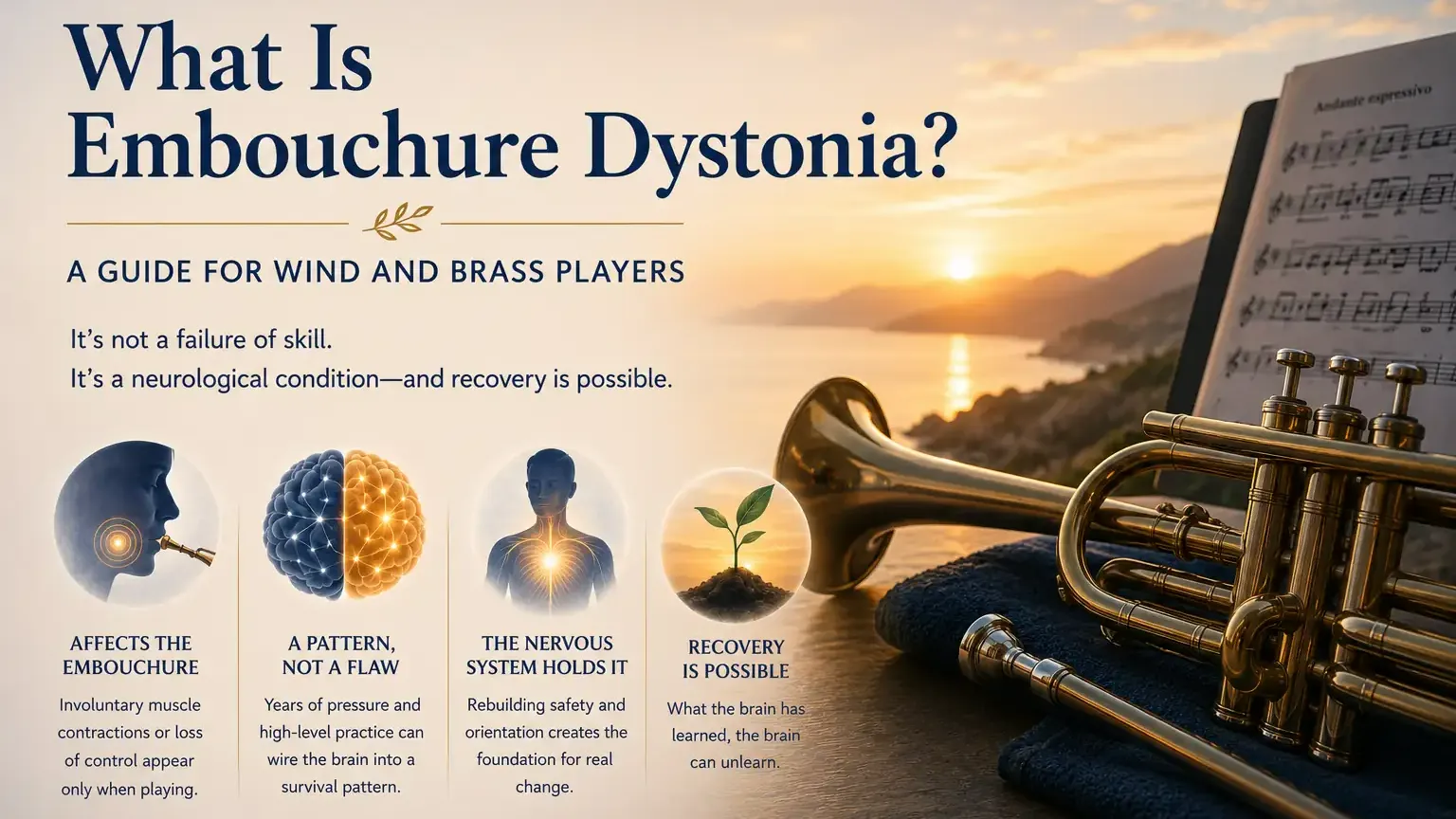
What Is Embouchure Dystonia? A Guide for Wind and Brass Players
Jul 30, 2026When the embouchure stops answering
For a wind or brass player, the embouchure is not a technique. It is an instrument in itself — the exquisitely coordinated system of lips, facial muscles, tongue and jaw through which years of music have passed. So when it begins to fail, and fail only when it matters, the experience is bewildering and frightening. A note that will not centre. A tremor that appears in performance but vanishes at home. A lip that pulls, locks, or refuses to hold the aperture it has held ten thousand times before.
This is embouchure dystonia, and it is one of the most distressing forms of focal dystonia precisely because it strikes at the most intimate and least visible part of a player’s craft. If you are living with it, the first thing to know is that it is a recognised neurological condition, it is not a collapse of your ability or character, and recovery is possible.
If you’re living with this, our free guide is a gentle place to start.
What embouchure dystonia actually is
Embouchure dystonia is a task-specific focal dystonia affecting the muscles used to control the flow of air and the shape of the mouth in wind and brass playing. Like all focal dystonias, it involves involuntary muscle contractions or weakness — pulling, tremor, or loss of fine control — that appear during a specific, highly-practised task and are typically absent in ordinary life.¹ A player may speak, eat, and smile without difficulty, yet find that the moment they bring the instrument to their lips, the coordination unravels.
It is task-specific in an even finer sense than that. It may affect only certain registers, certain dynamics, or certain articulations, appearing on high notes but not low ones, or in soft playing but not loud. This specificity is one of its most confusing features, and one reason it is so often misread — as a technical fault, a mouthpiece problem, a lapse of nerve — before it is correctly recognised.
How common is it, and who does it affect?
Musician’s dystonia affects an estimated one to two per cent of professional musicians — far higher than the rate in the general population — and embouchure dystonia is well documented among brass and wind players in particular.² It tends to appear in dedicated, accomplished players, often in mid-career, after years of high-level practice and performance. That is not a coincidence. The very intensity of training that produces mastery is part of what creates the conditions for the condition to develop.
Why it is not embouchure collapse — and why that matters
It is important to distinguish embouchure dystonia from embouchure collapse or overuse injury, which are muscular problems of fatigue, strain, or breakdown. Embouchure dystonia is neurological. The muscles themselves are healthy; the problem lies in the movement signals reaching them. This distinction matters enormously, because the two require completely different responses. Rest and strengthening may help an overuse injury; applied to dystonia, they rarely resolve it, and effortful retraining often makes it worse.³
This is why so many players spend months or years adjusting mouthpieces, changing technique, or drilling harder, only to find the problem deepening. They are treating a movement error that is really being generated at the level of the nervous system.
Why it develops: the gifts under pressure
People who develop focal dystonia tend to carry a distinctive set of innate gifts, and in wind and brass players these are often especially pronounced. There is the Attuned Empath’s deep sensitivity — the capacity to hear the smallest imperfection and feel the resonance of a phrase. There is the Sensitive Aesthetic’s exacting response to the quality and beauty of sound. There is a natural Discipline and Constancy that sustains thousands of hours of patient practice, and a Resilience and Determination that keeps a player going through difficulty.
These are extraordinary human capacities. But when they develop within environments that cannot fully meet them — high-pressure training cultures, competitive conservatoires, the constant proximity of judgement — the nervous system adapts. The Attuned Empath begins to brace for criticism and tie safety to approval. The Sensitive Aesthetic implodes into perfectionism and self-criticism. Discipline hardens into tense, driven pushing; resilience becomes force. Over years, that survival state becomes written into the body — and the embouchure, the most sensitive instrument the player owns, is often where it finally speaks. The dystonia is not the truth of who you are, and it is not a fixed trait woven into your personality. It is the body’s most honest communication after years of not being listened to.
Why the orienting system is part of the answer
There is a specific neurological reason that willpower and technical correction so often fail here. The neuroscientist Michael Posner identified distinct attentional networks in the brain, including an executive network, which governs conscious self-regulation, and an orienting network, which concerns where the self is in space — the body’s relationship to gravity, to its own midline, to its physical position.⁴ When a player tries to consciously override a dystonic movement, they are using the executive network. But Posner’s work showed that the executive network cannot function fully without a well-developed orienting network beneath it — and in a nervous system held in survival, the orienting foundation is exactly what becomes disrupted.
This is why the Focal Dystonia Method works with the body’s orientation in space and with orientational eye positions before, and beneath, any attempt to change the movement itself. It rebuilds the foundation on which genuine self-regulation depends, rather than demanding that the player simply try harder to control what cannot be controlled by effort alone.
Our Deep Dive course shows how this nervous-system work is done.
Recovery is possible
Embouchure dystonia can feel like the end of a musical life. It is not. Because the pattern was learned through the brain’s capacity for change, it can be unlearned through that same capacity — when the nervous system is guided back to safety and the adaptations holding the survival state are recognised and released. What has been learned can be unlearned. The embouchure that stopped answering can, in time, answer again.
If you recognise yourself in this, recovery is possible. Explore the Focal Dystonia Method programme to understand the path forward.
References
- Natural history and clinical features of embouchure dystonia: Frucht SJ, Fahn S, Greene PE, et al. The natural history of embouchure dystonia. Movement Disorders. 2001;16(5):899–906.
- Prevalence and mechanisms of musician’s dystonia: Altenmüller E, Jabusch HC. Focal dystonia in musicians: phenomenology, pathophysiology and triggering factors. European Journal of Neurology. 2010;17(Suppl 1):31–36.
- Degraded sensory maps in focal hand and task-specific dystonia: Elbert T, Candia V, Altenmüller E, et al. Alteration of digital representations in somatosensory cortex in focal hand dystonia. NeuroReport. 1998;9(16):3571–3575.
- Attentional networks and the orienting system: Posner MI, Petersen SE. The attention system of the human brain. Annual Review of Neuroscience. 1990;13:25–42.