
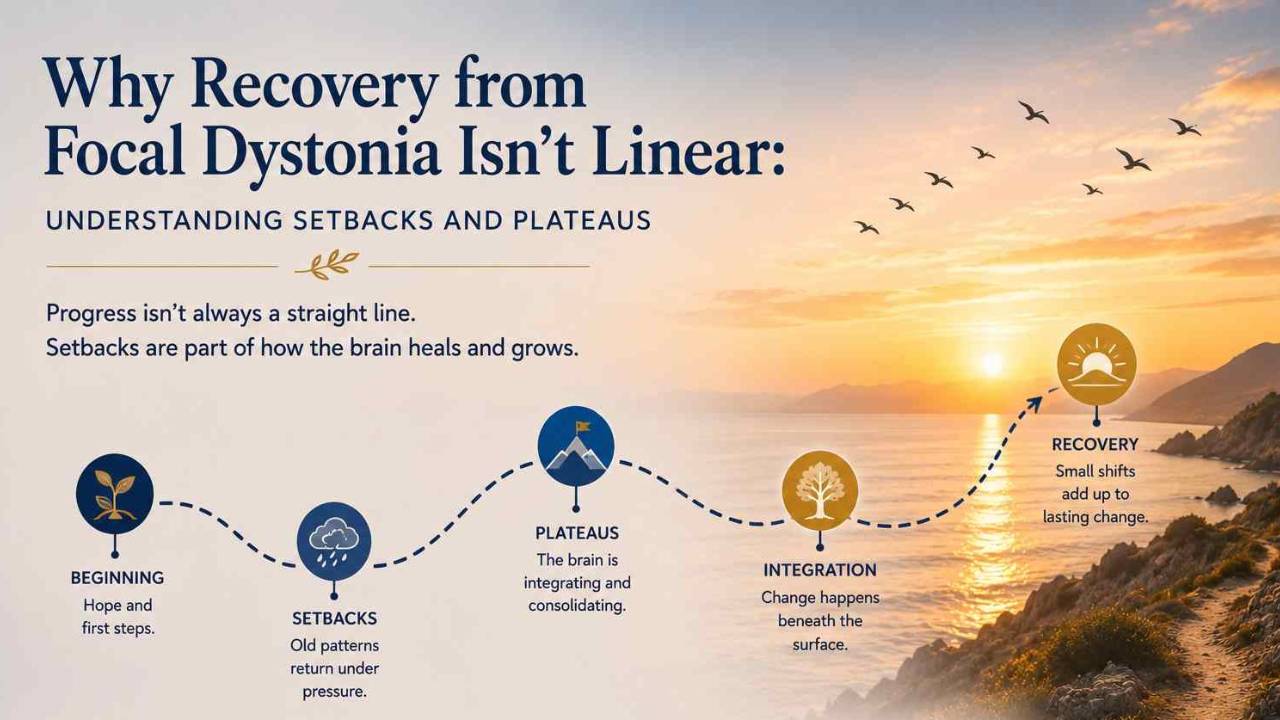
Why Recovery from Focal Dystonia Isn’t Linear: Understanding Setbacks and Plateaus
Aug 06, 2026The moment that undoes so many people
There is a particular moment in focal dystonia recovery that quietly ends more attempts than any other. It is not the beginning, which people approach with hope. It is the point, weeks or months in, when real progress has been made — and then it seems to slip. A movement that had begun to soften tightens again. A good stretch is followed by a flat one. And the old, familiar verdict arrives: it isn’t working after all.
Almost always, that verdict is wrong. Setbacks and plateaus are not evidence that recovery has failed. They are a normal, expected, and neurologically explicable feature of how the nervous system changes. Understanding why turns those moments from proof of hopelessness into ordinary weather on a path that is still moving forward.
If you’d like somewhere to steady yourself, our free guide is a good place to begin.
Recovery is reorganisation, and reorganisation is uneven
The straight line is a fantasy the mind prefers, not a description of how brains learn. Neuroplastic change — the reorganisation that recovery depends on — happens in fits and consolidations, not in smooth increments. Established principles of experience-dependent plasticity describe change that is gradual, uneven, and dependent on repetition, timing, and state.¹ Some of the most important consolidation happens during rest and sleep, offline, when nothing visible is occurring at all.² A plateau, in other words, is often not a stall but a settling — the system integrating a change before the next one becomes visible.
This is why a flat week can precede a noticeable shift, and why pushing harder during a plateau tends to backfire. The reorganisation is happening beneath the surface, on its own timeline, whether or not the symptom is cooperating.
Why old patterns return under pressure
The second reason recovery is non-linear is one of the most reassuring things to understand. When the nervous system builds a new, freer response, the old pattern is not erased. It is inhibited. The new pathway is laid down alongside the old one, and what recovery gives you is the growing ability to access the new response instead of the old.³
The practical consequence is that under sufficient stress, fatigue, or a strongly charged cue, the old pattern can reassert itself — not because recovery has been lost, but because the conditions momentarily favoured the older, more deeply grooved response. This is well established in the science of how learned responses extinguish and return: the original pattern persists, and context determines which response is expressed.⁴ A setback under pressure is not a return to square one. It is the old groove briefly winning a contest it will, over time, increasingly lose.
A setback is not the pattern coming back.
It is the new pattern being tested — and learning to hold.
The role the gifts play in setbacks
There is also an emotional dimension, and it tends to run along the lines of the very gifts that shaped the condition. The person with deep Resilience and Determination meets a plateau by gritting their teeth and pushing — the gift in its survival shape, force rather than steadiness — which re-activates the state the work is trying to soften. The Attuned Empath reads the setback as a verdict on their worth. The person with exacting Discipline and Constancy turns the plateau into evidence of failure and self-criticism.
Recognising this is part of the work. The plateau is not only a neurological event; it is a moment that reliably summons the adapted version of your gifts. Meeting it instead from the healthy version — steadiness rather than force, discernment rather than self-judgement — is often what allows the next shift to come. Slow is smooth, and smooth is fast.
What to actually do when recovery stalls
First, do not interpret. A plateau is not a message about whether recovery is possible; it is a phase, and phases pass. Resist the urge to make it mean something about you or your future.
Second, do not push. The instinct to intensify effort during a stall is the survival pattern reasserting itself, and it tends to entrench the very state you are working to release. This is the counter-intuitive heart of it: during a plateau, doing less, and doing it with more kindness, usually serves better than doing more.
Third, keep the conditions consistent. Return to the foundational practices, they will give you the ability to resist the urge to make it mean something or to enter into the old patterns and state of pushing and micromanaging. Maintain regularity in your practice in spirit and in form, protect sleep and rest, and continue to meet the nervous system with safety rather than demand. The consolidation that a plateau represents needs stable ground, not a change of strategy.
And fourth, widen the measure. Recovery from focal dystonia shows up in far more than the symptom — in ease, in emotional range, in the return of a kinder relationship with yourself and your craft. On a week when the movement is flat, those measures often keep moving. They are not consolation prizes. They are the ground from which the movement change grows.
Our Deep Dive course walks you through the work itself, step by step.
The shape of the whole path
If you could see the whole arc from above, it would not be a line. It would be a series of gains, settlings, and small reversals that, over time, trend unmistakably toward freedom. The reversals are not the exception to recovery. They are part of its shape. Knowing that in advance is one of the most protective things a person in recovery can carry — because it means the hardest moments no longer have the power to end the journey.
If you are ready to explore the programme, you can find full details and enroll at focaldystoniamethod.com.
References
- Principles of experience-dependent plasticity: Kleim JA, Jones TA. Principles of experience-dependent neural plasticity: implications for rehabilitation after brain damage. Journal of Speech, Language, and Hearing Research. 2008;51(1):S225–S239.
- Offline and sleep-dependent motor consolidation: Walker MP. A refined model of sleep and the time course of memory formation. Behavioral and Brain Sciences. 2005;28(1):51–64.
- New learning inhibits rather than erases old pathways: Milad MR, Quirk GJ. Fear extinction as a model for translational neuroscience: ten years of progress. Annual Review of Psychology. 2012;63:129–151.
- Context, extinction and the return of learned responses: Bouton ME. Context and behavioral processes in extinction. Learning & Memory. 2004;11(5):485–494.
- Basal ganglia, habit and the evaluative brain: Graybiel AM. Habits, rituals, and the evaluative brain. Annual Review of Neuroscience. 2008;31:359–387.