
What Is Neuroplasticity, and Why Does It Make Recovery from Focal Dystonia Possible?
Jul 23, 2026The single most hopeful word in this whole field
If there is one idea that changes everything about how focal dystonia is understood, it is this: the brain is not a fixed machine. It is a living, changing structure that reshapes itself in response to what we ask of it, throughout the whole of life. The word for that capacity is neuroplasticity — and it is the reason recovery is possible.
This matters because most people arrive at focal dystonia having been told, in one way or another, that their situation is permanent. That the wiring is faulty. That the best they can hope for is management. Neuroplasticity is the scientific answer to that despair. The same property of the brain that allowed the dystonic pattern to form is the property that allows it to release.
If this is new to you, our free guide is a clear place to begin.
What neuroplasticity actually means
Neuroplasticity is the brain’s ability to change its own structure and function in response to experience. Every skill you have ever learned — speaking, walking, opening a door, cooking, reading, playing an instrument, performing surgery, throwing a ball — was laid down through this process. Repeated, attended experience strengthens the connections between neurons, and those strengthened connections become the physical trace of the skill in the brain.
For a long time this was thought to be a feature only of childhood. It is not. In a now-famous study, researchers scanned the brains of adults before and after they learned to juggle, and found measurable growth in the grey matter of regions involved in processing movement — growth that appeared with practice and receded when practice stopped.¹ The adult brain changes its physical structure in response to what it repeatedly does. This is not a metaphor. It is visible on a scan.
Neuroplasticity even extends to the birth of new neurons. The adult human brain continues to generate new cells in regions associated with learning and emotional regulation — a process called neurogenesis — well into later life.² The old belief that we are born with all the brain cells we will ever have, and only lose them, turned out to be wrong.
How the same capacity built focal dystonia
Here is the part that is less comfortable, and more important. The very capacity that makes recovery possible is also what allowed focal dystonia to develop in the first place. Neuroplasticity is not inherently benign. It responds to whatever is repeated — helpful or not.
In the brain, adjacent parts of the body are represented by adjacent territories in the sensory and motor maps. When a movement is practised intensely, precisely, and under pressure — thousands of hours of the same fine action — those maps can begin to blur. Research on musicians with hand dystonia has shown that the normally distinct representations of individual fingers become smeared together, overlapping where they should be separate.³ A landmark primate model demonstrated the same thing: highly repetitive, attended hand movements degraded the orderly map of the hand in the brain, producing precisely the loss of fine control seen in focal dystonia.⁴
This is what is meant by maladaptive plasticity. The brain, doing exactly what it is designed to do — refining and automating a heavily used pattern — refined it too far, or refined it under conditions of threat, and the result was a loss of the very control the person was working to perfect. The principle underneath is the one the neurobiologist Carla Shatz summarised as “neurons that fire together wire together,” a memorable phrasing of a learning rule first proposed by Donald Hebb.⁵ What fires together, wires together — whether or not that wiring serves us.
Why this reframing is the ground of hope
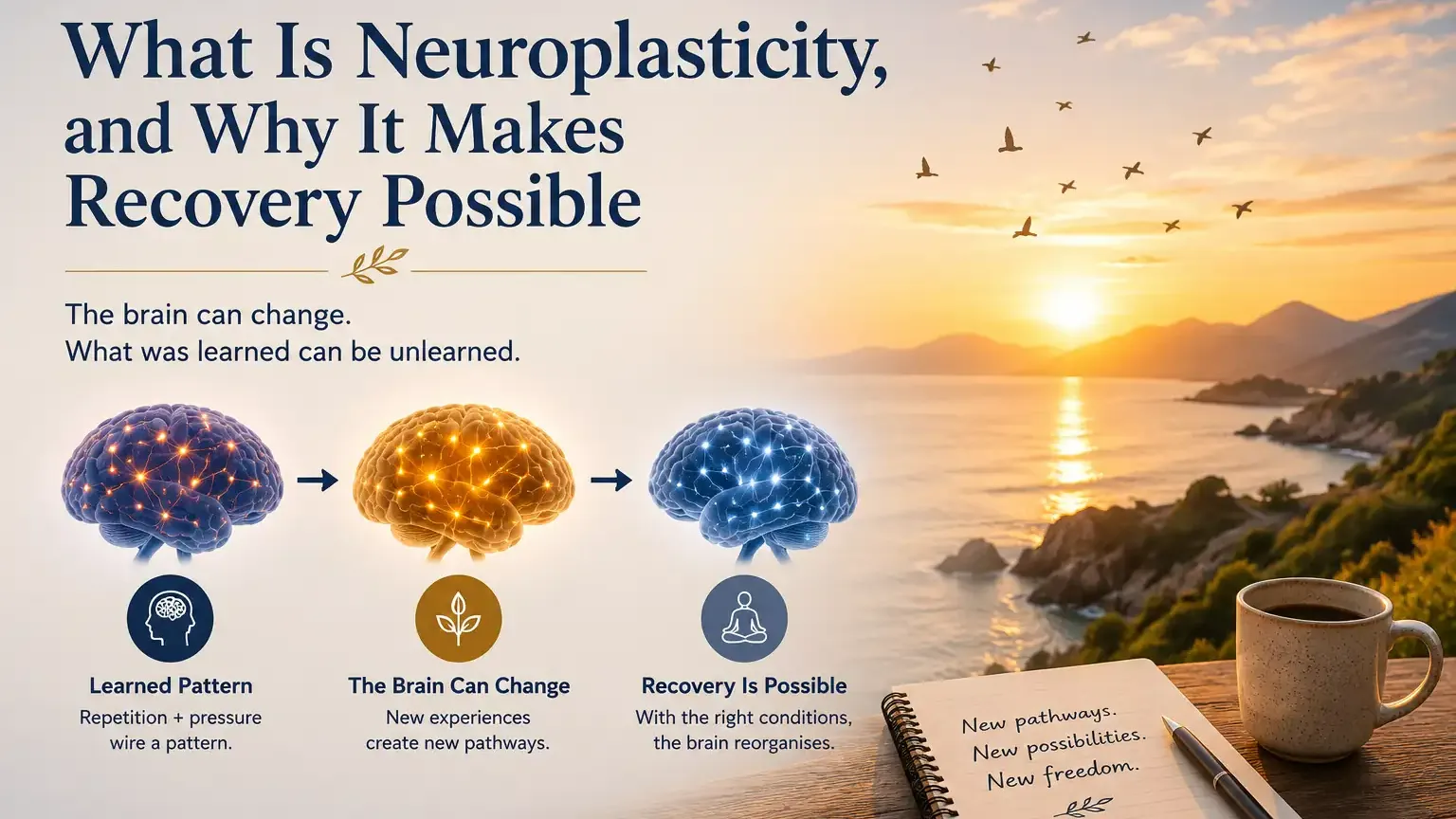
If the pattern were a structural defect — something broken in the hardware — there would be little to be done. But a pattern that was learned through plasticity can be changed through plasticity. This is the whole basis of the Focal Dystonia Method, and it is not wishful thinking. It follows directly from how the brain works.
The important nuance is that plasticity is gated by attention and by state. Not everything we do reshapes the brain — only what we attend to, and what carries meaning or emotional charge, drives lasting change.⁶ This is why mindless repetition does not help, and why forcing the movement often makes things worse: it pours attention and threat into the very pattern that needs to soften. And it is why the conditions in which the brain is asked to change matter enormously. A nervous system in survival cannot lay down new, freer patterns; a nervous system in genuine safety can.
The dystonic movements, in this light, are not the truth of who you are, and they are not some fixed trait woven into your personality. They are a pattern — an intelligent, if costly, adaptation — held in place by state and repetition. Change the state, change what is repeated, and give it time, and the brain does what it has always done: it reorganises.
Curious how the brain is guided to do exactly that? Our Deep Dive course walks you through it.
What this means for your recovery
Neuroplasticity gives us three practical principles. First, that change is possible at any age — the studies are consistent on this, and Ruth has worked with people who recovered after decades. Second, that how you practise matters far more than how much: attended, unhurried, safe engagement reshapes the brain; anxious, forced repetition entrenches the pattern. Third, that recovery is a process of reorganisation, not repair — you are not fixing a broken part but helping a capable brain lay down a different, freer pattern.
What has been learned can be unlearned. That sentence is not a slogan. It is a summary of the neuroscience of plasticity — and it is the reason there is a path forward.
To understand how this applies to your own recovery, explore the full programme.
If you are a therapist wanting to work with this approach, Ruth offers professional certification at ruthslchiles.com/certification.
References
Byl, N. N., Merzenich, M. M., & Jenkins, W. M. (1996). A primate genesis model of focal dystonia and repetitive strain injury. ‘Neurology, 47’(2), 508–520. https://doi.org/10.1212/wnl.47.2.508
Draganski, B., Gaser, C., Busch, V., Schuierer, G., Bogdahn, U., & May, A. (2004). Neuroplasticity: Changes in grey matter induced by training. ‘Nature, 427’(6972), 311–312. https://doi.org/10.1038/427311a
Elbert, T., Candia, V., Altenmüller, E., Rau, H., Sterr, A., Rockstroh, B., Pantev, C., & Taub, E. (1998). Alteration of digital representations in somatosensory cortex in focal hand dystonia. ‘NeuroReport, 9’(16), 3571–3575. https://doi.org/10.1097/00001756-199811160-00006
Eriksson, P. S., Perfilieva, E., Björk-Eriksson, T., Alborn, A. M., Nordborg, C., Peterson, D. A., & Gage, F. H. (1998). Neurogenesis in the adult human hippocampus. ‘Nature Medicine, 4’(11), 1313–1317. https://doi.org/10.1038/3305
Hebb, D. O. (1949). ‘The organization of behavior: A neuropsychological theory.’ Wiley.
Pascual-Leone, A., Amedi, A., Fregni, F., & Merabet, L. B. (2005). The plastic human brain cortex. ‘Annual Review of Neuroscience, 28’, 377–401. https://doi.org/10.1146/annurev.neuro.27.070203.144216
Shatz, C. J. (1992). The developing brain. ‘Scientific American, 267’(3), 60–67. https://doi.org/10.1038/scientificamerican0992-60