
Why Recovery from Focal Dystonia Takes Time: The Neuroscience of Lasting Change
Sep 03, 2026The question people ask
If the nervous system caused this, and the nervous system can change — why does recovery take so long?
It is a reasonable question. And the answer is not about pessimism or limitation. It is about how the brain actually works.
New to this? Our free guide is a gentle place to begin.
How neural patterns are built
The nervous system learns through repetition. Every movement you have drilled, every emotional response that became habitual, every pattern of bracing or withholding or concealing — these became embedded through the same process: experience, repeated consistently, over time. The more the pattern was repeated, and the earlier in life it was established, the more deeply it was encoded.
This is not a metaphor. It describes the actual biology of neural pathway formation. Neurons that fire together wire together (Hebb, 1949; Shatz, 1992). Patterns practised across years — particularly during the neurologically formative period of adolescence — become structural. They are not a layer on top of the nervous system. They are woven into its architecture.
This applies to everyone who develops focal dystonia — not only professional performers. Whether the movement in question is a string musician’s vibrato, a surgeon’s precision hold, a craftsperson’s technique, or a writer’s grip: the same principle holds. The finely trained movements that focal dystonia disrupts are embedded alongside the emotional environment in which they were learned. Both take time to change.
Why the cue environment matters
Neuroscience research on trauma and fear is clear on one point: neural pathways built through fear are not erased by new learning alone. They are inhibited. The old pathway remains. What changes is the nervous system’s ability to choose — to access a new response when the familiar cue appears (Hanson, 2025).
For someone who has experienced sustained anxiety in relation to a specific activity, the environment of that activity becomes a cue. These are not neutral stimuli. They carry the charge of whatever emotional history has accumulated around them. The nervous system responds to them before conscious thought has a chance to intervene.
This is why recovery is not possible whilst remaining continuously within the conditions that maintain the current pattern. The cues are too powerful. The fear pathways too well-established. Every return to the pressure context re-activates the system that needs to change.
Asking the nervous system to heal whilst it remains involved in the very patterns that produced the injury is, neurologically, the equivalent of asking a broken bone to mend whilst continuing to bear full weight on it. The metaphor is not poetic. It describes a structural reality.
What changes when the conditions change
When the pressure is genuinely removed — not as a brief pause before an expected return, but as a real and new internal environment — the nervous system begins to do something it could not do whilst it was continuously mobilised. It settles.
The neural changes associated with chronic stress, whilst real, are reversible. The fascial tissue that has stiffened under sustained cortisol exposure begins to soften when the stress chemistry changes (Wilke et al., 2021). The hippocampus — the brain structure most impaired by chronic stress, and the one most important for flexible, contextually appropriate learning — begins to regenerate when the chronic stress is removed (Bhagya et al., 2018). New associations become possible: the possibility that the movement is safe, that the activity can be approached without bracing.
These changes do not happen quickly. But they do happen — and they happen reliably, given the right conditions.
Our Deep Dive course walks you through creating those conditions.
What the right conditions are
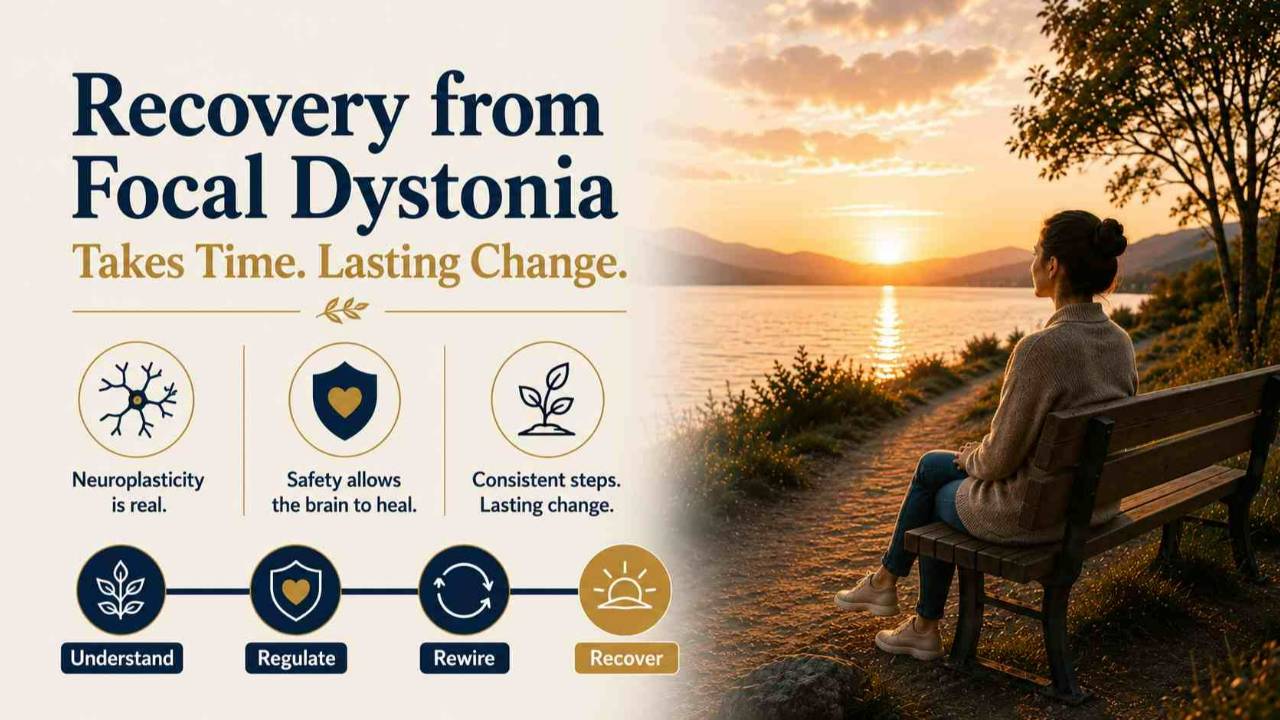
The neuroscience of lasting change identifies three requirements: new experience, repeated consistently, in genuine safety (Hanson, 2025).
Each of these matters. New experience alone — without repetition — does not build a new pattern. Repetition without safety keeps the nervous system in a state where it cannot genuinely integrate what it is experiencing. And safety that is intermittent or conditional does not reach the depth at which the anxiety has been built.
This is why the Focal Dystonia Method works as it does. The programme is not a short intervention. It is a process — one that works systematically at the level of the nervous system, addressing the developmental roots of the anxiety, rebuilding the conditions in which the sensorimotor system can reorganise. The dystonia follows the nervous system. Recovery at the level of the movement is a consequence of recovery at the level of the system that drives it.
A word about what recovery actually feels like
Recovery is not a straight line. It does not feel like steady progress toward a clear destination. It feels, often, like the ground shifting — periods of unexpected ease followed by periods of uncertainty, moments of genuine shift followed by the return of familiar patterns. This is not failure. It is the nature of neurological reorganisation.
The nervous system does not change all at once. It changes in the way the body heals: layer by layer, from the inside out, in its own time. The work is not to force that process. It is to create the conditions in which it can happen — and to trust, with the support of the science, that it will.
What has been learned can be unlearned. The nervous system that built this pattern can build a new one. It needs time. It needs safety. And it needs to be met without the pressure that produced the problem in the first place.
Learn more about the Focal Dystonia Method Programme
References
Bhagya, V., Shankaranarayana Rao, B. S., & Bhaskaran, S. (2018). Recovery of chronic stress-triggered changes of hippocampal glutamatergic transmission. ‘Neural Plasticity, 2018,’ Article 4053572. https://doi.org/10.1155/2018/4053572
Hanson, R. (2025). ‘Hardwiring happiness: The new brain science of contentment, calm, and confidence.’ Harmony.
Hebb, D. O. (1949). ‘The organization of behavior: A neuropsychological theory.’ Wiley.
Shatz, C. J. (1992). The developing brain. ‘Scientific American, 267’(3), 60–67. https://doi.org/10.1038/scientificamerican0992-60
Wilke, J., Schleip, R., Wearing, S. C., & Klingler, W. (2021). The lumbodorsal fascia as a potential source of low back pain: A narrative review. ‘BioMed Research International, 2021,’ Article 7973365.