
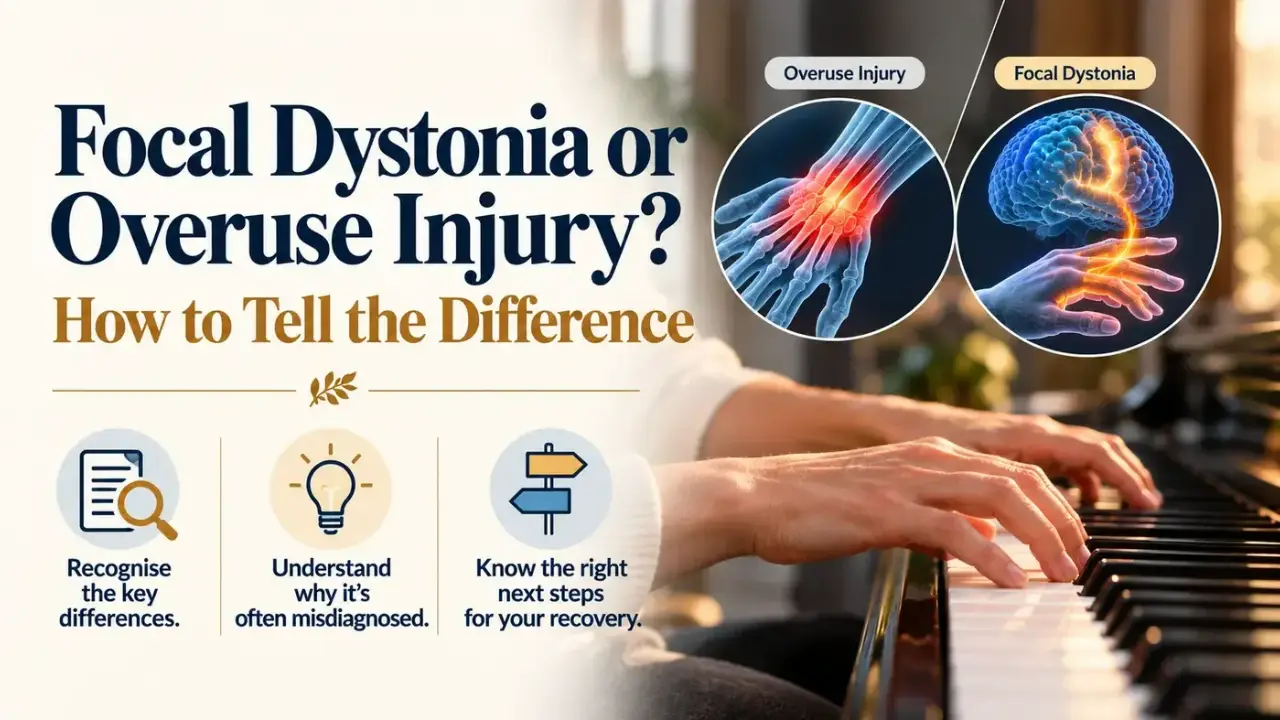
Focal Dystonia or Overuse Injury? How to Tell the Difference
Oct 01, 2026"I've been treated for tendonitis for eighteen months. I've had rest, anti-inflammatories, physiotherapy, a splint, and a long and expensive look at my technique. Nothing has made any difference at all, and I've started to wonder whether anyone actually knows what's wrong with me. The strange thing — the thing nobody has ever really explained — is that it doesn't hurt. It has never hurt. My hand simply won't do what I ask it to, and only when I'm playing. So how do I find out what this really is?"
The short answer
The absence of pain is the detail worth paying attention to, and it is one of the most reliable pointers there is.
Overuse injuries are problems of tissue, and tissue that is inflamed or strained generally hurts. Focal dystonia is a problem of the movement signal, and it is usually painless.¹ ² A hand that will not obey but does not hurt, and that fails only at one highly practised task, is far more likely to be dystonic than injured.
This distinction is not academic. The two conditions call for opposite responses, and eighteen months of the wrong treatment is a common story.
New here? Our free guide is a clear, kind place to begin.
What are the differences that actually matter?
Five, in rough order of usefulness.
Pain. Overuse injuries typically hurt, and the pain is often worse during and after playing. Focal dystonia is characteristically painless. Some people do experience secondary aching from compensating, but the primary problem does not announce itself as pain.
Task-specificity. An injured tendon is injured all day. It complains when you open a jar, carry shopping, or use a keyboard. Focal dystonia is task-specific to a degree that patients often find hard to describe without feeling foolish: the hand that fails in one register of one instrument works perfectly for everything else.
Response to rest. This is the clearest practical test, and most people have unwittingly performed it already. Overuse injuries improve with rest and worsen with a return to load. Focal dystonia is almost exactly where you left it after three months away.
What the failure looks like. Injuries produce pain, weakness and fatigue. Dystonia produces the wrong movement: a finger that curls or lifts of its own accord, a tremor, a loss of independence between fingers, a grip that tightens without instruction.
Onset. Overuse tends to follow an identifiable increase in load — a heavy touring schedule, a change of repertoire, a new instrument. Dystonia more often creeps in gradually, over months, without a clear precipitating event, in a player at the height of their competence.
Why does it get misdiagnosed so often?
Because the presentation is genuinely confusing, and because focal dystonia is uncommon enough that a general practitioner or physiotherapist may see very few cases.
It also arrives in the wrong order. The first symptom is usually a subtle loss of control that the player interprets as a technical fault, so the first consultation is often with a teacher rather than a clinician. By the time a medical opinion is sought, the story has become "my technique has deteriorated", which points naturally towards strain.
And the tests come back normal. There is no blood test, no scan, no nerve conduction study that shows focal dystonia. Diagnosis is clinical — made by an experienced neurologist watching the movement and taking a careful history.³ ⁴ A normal MRI is entirely consistent with dystonia; it is not reassurance that nothing is wrong.
Our Deep Dive course explores how this is worked with in recovery.
Can I have both?
Yes, and it is not unusual. A player may develop a genuine overuse injury, alter their technique to work around it, and develop dystonia in the altered pattern. Others compensate for a dystonic hand until the compensation itself produces strain.
Where both are present, they still need to be treated as two separate things. The injury needs rest and rehabilitation; the dystonia needs the nervous system addressed. Treating either one as though it were the other is what produces years without progress.
What should I do if I think this is dystonia?
Ask for a referral to a neurologist, ideally one with an interest in movement disorders, and if you are a performer, say so — performing arts medicine clinics exist and are far more likely to recognise the pattern quickly.
Take a video of the movement failing. This is the single most useful thing you can bring, because dystonia is often shy in a consulting room without the instrument.
And in the meantime, stop treating it as strain. Rest is not harmful, but the months spent on it are, if they delay recognising what this actually is — and the harder, more determined practice that people usually try next tends to deepen the pattern rather than wear it away.
FAQ
Does focal dystonia hurt?
Usually not. Focal dystonia is characteristically painless. Some people have secondary aching from compensating with other muscles, but pain as the main symptom points more towards an overuse or musculoskeletal problem.
Can a scan diagnose focal dystonia?
No. There is no scan or blood test that confirms focal dystonia. Diagnosis is clinical, based on observing the movement and taking a history. Normal imaging does not rule it out.
How do I know if it's RSI or dystonia?
The most useful questions are whether it hurts, whether it affects everyday activities as well as the trained task, and whether it improved with rest. Pain, everyday involvement and improvement with rest point to injury; painlessness, strict task-specificity and no change after rest point to dystonia.
How long does focal dystonia take to diagnose?
It is commonly missed for a year or more, often after treatment for tendonitis or RSI. Bringing a video of the movement to the consultation, and asking specifically about task-specific dystonia, tends to shorten that considerably.
Will physiotherapy help focal dystonia?
Conventional strengthening and stretching physiotherapy addresses tissue, which is not what has changed in dystonia. Specialist retraining approaches, and work at the level of the nervous system, are what change the pattern.
Can focal dystonia be caused by an injury?
An injury can precede dystonia, and altered movement adopted to protect an injury can become the pattern in which dystonia develops. The injury itself is not usually the whole explanation.
References
Clinical features of task-specific dystonias: Torres-Russotto D, Perlmutter JS. Task-specific dystonias: a review. Annals of the New York Academy of Sciences. 2008;1142:179–199.
Distinguishing dystonia from playing-related musculoskeletal disorders: Lederman RJ. Neuromuscular and musculoskeletal problems in instrumental musicians. Muscle & Nerve. 2003;27(5):549–561.
Clinical assessment of movement disorders in musicians: Jankovic J, Ashoori A. Movement disorders in musicians. Movement Disorders. 2008;23(14):1957–1965.
Modern formulation of focal task-specific dystonia: Frucht SJ. Focal task-specific dystonia — from early descriptions to a new, modern formulation. Tremor and Other Hyperkinetic Movements. 2014;4:230.