
Why the Brain's Map of the Hand Blurs: Sensory Retraining and Focal Dystonia
Sep 24, 2026The brain has a map of you
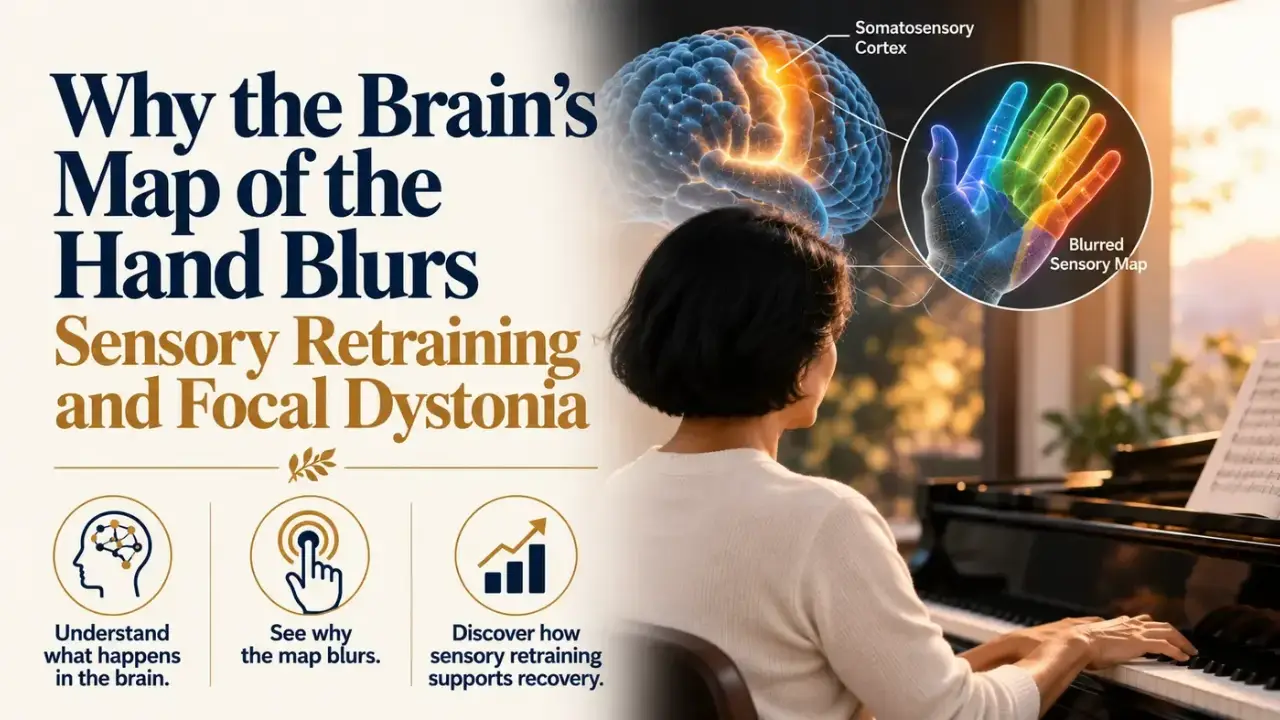
Somewhere along the strip of cortex that runs across the top of your head, your body is laid out in miniature. Each part of the skin has its own territory: the face here, the thumb here, the index finger next to it, then the middle finger, and so on, in order. The map is not decorative. It is how the brain knows which finger is which.
The remarkable thing about this map — and the thing that matters for focal dystonia — is that it is not fixed at birth. It is drawn and redrawn throughout life by what you do. A violinist's left-hand fingers occupy noticeably more cortical territory than a non-musician's. That is neuroplasticity doing exactly what it is supposed to do.
But a map that can grow can also blur.
New here? Our free guide is a clear, kind place to begin.
The monkeys that changed the field
In 1996, Nancy Byl and Michael Merzenich set out to test an idea about repetitive strain. They trained monkeys on a rapid, repetitive, highly attended hand task, performed over and over for months, and then looked at the sensory map of the hand in the primary somatosensory cortex.¹
What they found was not damage. It was disorganisation. The neat borders between the digits had degraded. Receptive fields had enlarged and begun to overlap, so that a single patch of cortex now responded to several fingers at once, and to skin surfaces that should have been separately represented. The map had lost its resolution — and motor control had deteriorated alongside it.
The word often used for this is smudging, and it is a good one. Nothing had been destroyed. The lines had simply been rubbed together.
The same picture in human hands
Within two years, the same degradation had been documented in people. Studies of musicians and others with focal hand dystonia found the cortical representations of the affected fingers sitting abnormally close together, disordered where they should be distinct — a somatosensory map that had lost its separations.² ³
This finding reframes the condition. If the brain's map of the fingers has blurred, then the brain no longer has clean information about which finger is which. And a motor system asked to move one finger precisely, on the basis of a map in which several fingers occupy overlapping ground, will produce exactly what focal dystonia looks like: the intended movement, contaminated by movements that were not asked for.
The other half: the lost quiet
Sensory blurring is only half the picture. The second finding is about inhibition.
Skilled movement is as much an act of restraint as of activation. To move one finger cleanly, the brain must actively suppress the muscles that should stay still — a process known as surround inhibition, the neurological equivalent of quieting an orchestra so that a solo can be heard. In dystonia, that suppression is impaired at several levels of the nervous system.⁴ ⁵
Put the two findings together and the condition becomes intelligible. The map has lost its detail, and the system has lost its capacity to keep the surrounding voices quiet. The result is not weakness and not paralysis, but overflow: too much movement, in too many places, at the moment when the finest control is required.
Our Deep Dive course explores how this is worked with in recovery.
What actually drives the blurring
Here is the part that is most often left out, and it is the part that matters most for recovery.
Cortical maps are not reshaped by repetition alone. They are reshaped by repetition combined with attention and significance — the brain redraws the territory that it is paying close, meaningful, effortful attention to. This is why the monkeys' task had to be highly attended to produce the effect, and why not every musician who practises for ten thousand hours develops dystonia.
It also explains why the emotional environment of practice is not incidental. Years of highly attended repetition, performed under evaluation, in a body braced against the possibility of failure, are a far more potent recipe for maladaptive reorganisation than the same hours performed in ease. And it explains why musician's dystonia and writer's cramp — superficially similar, but shaped by very different histories of attention — show measurably different physiology.⁶
The dystonia, in other words, is not evidence that you practised too much. It is evidence of the conditions in which you practised.
What this predicts about recovery
A map that was blurred by experience should be capable of being sharpened by experience, and this is precisely what has been found. Eight weeks of Braille reading — an intensive but calm exercise in sensory discrimination — improved spatial acuity in patients with focal hand dystonia, with objective improvement in the dystonia in around half of them.⁷ Approaches that restore separation between the fingers during playing have produced measurable gains in affected musicians.⁸
These results are genuine, and they are also incomplete on their own. What they demonstrate is the principle: the map responds to what you give it. What they do not address is the state in which the giving happens.
This is the point at which the science and the Focal Dystonia Method meet. If maps are redrawn by attended repetition, then the quality of attention is not a detail of the method — it is the active ingredient. Attention that is anxious, inward and self-monitoring is the attention under which the smudging was learned. Attention that is soft, oriented, outward and unhurried is a different input altogether, and it is what the work is designed to make possible. Slow is smooth, and smooth is fast, for a reason that is written into the mechanism.
What has been learned can be unlearned
The most hopeful sentence in this whole field is also the most literal. Nothing in focal dystonia has been destroyed. No tissue has been lost, no pathway severed. What has happened is that a living, changing map has been drawn in a particular way, under particular conditions, over a long period of time.
Change the conditions, and the map can be drawn again.
To understand how this applies to your own recovery, explore the full programme at focaldystoniamethod.com.
If you are a therapist wanting to work with this approach, Ruth offers professional certification at ruthslchiles.com/certification.
References
Learning-induced degradation of the cortical hand map: Byl NN, Merzenich MM, Jenkins WM. A primate genesis model of focal dystonia and repetitive strain injury: I. Learning-induced dedifferentiation of the representation of the hand in the primary somatosensory cortex in adult monkeys. Neurology. 1996;47(2):508–520.
Altered digital representations in focal hand dystonia: Elbert T, Candia V, Altenmüller E, et al. Alteration of digital representations in somatosensory cortex in focal hand dystonia. NeuroReport. 1998;9(16):3571–3575.
Disordered somatosensory map in dystonia of the hand: Bara-Jimenez W, Catalan MJ, Hallett M, Gerloff C. Abnormal somatosensory homunculus in dystonia of the hand. Annals of Neurology. 1998;44(5):828–831.
Loss of inhibition in dystonia: Hallett M. Neurophysiology of dystonia: the role of inhibition. Neurobiology of Disease. 2011;42(2):177–184.
Inhibition, sensory abnormality and maladaptive plasticity: Quartarone A, Hallett M. Emerging concepts in the physiological basis of dystonia. Movement Disorders. 2013;28(7):958–967.
Pathophysiological differences between musician's dystonia and writer's cramp: Rosenkranz K, Williamon A, Butler K, Cordivari C, Lees AJ, Rothwell JC. Pathophysiological differences between musician's dystonia and writer's cramp. Brain. 2005;128(Pt 4):918–931.
Sensory training in focal hand dystonia: Zeuner KE, Bara-Jimenez W, Noguchi PS, Goldstein SR, Dambrosia JM, Hallett M. Sensory training for patients with focal hand dystonia. Annals of Neurology. 2002;51(5):593–598.
Sensory motor retuning in pianists and guitarists: Candia V, Schäfer T, Taub E, et al. Sensory motor retuning: a behavioral treatment for focal hand dystonia of pianists and guitarists. Archives of Physical Medicine and Rehabilitation. 2002;83(10):1342–1348.