
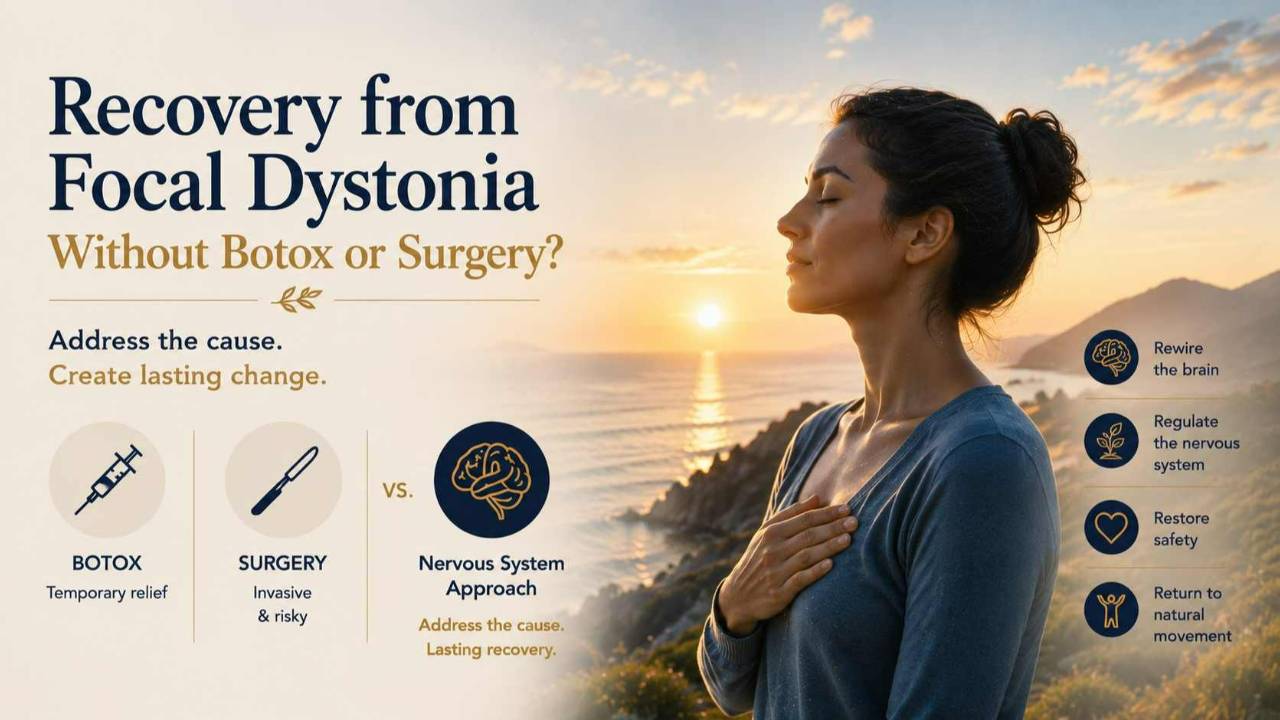
Can You Recover from Focal Dystonia Without Botox or Surgery?
Aug 27, 2026"My neurologist has offered me Botox, and mentioned surgery as a possibility further down the line. I'm grateful to have any options at all — but something about it doesn't sit right with me. I don't want to spend the rest of my life having injections every few months to mask a problem no one has really explained to me. What I want to know is whether there's another way. Is it genuinely possible to recover from focal dystonia without Botox or surgery — or is that just wishful thinking?"
The answer, directly
Yes. Recovery from focal dystonia without Botox or surgery is not only possible — it is, for many people, the route that produces lasting change rather than temporary relief. This is not a claim against medical treatment, which has its place and can be genuinely helpful for some. It is a statement about what each approach can and cannot do, and about where durable recovery actually comes from.
If you’re weighing up your options, our free guide is a clear place to begin.
What does Botox actually do — and what does it not do?
Botulinum toxin works by temporarily weakening the muscles into which it is injected, reducing the force of the dystonic contraction. For some people it provides meaningful, if partial, relief, and many find it a useful support while they do deeper work. Used well, it is a legitimate tool.
But it is important to be clear about what it is: a symptomatic treatment. It does not address what is driving the dystonic pattern in the nervous system. Its effect wears off, typically within a few months, requiring repeated injections; dosing the fine muscles involved in tasks like playing an instrument is notoriously difficult; and because it treats the surface expression rather than the root, the underlying pattern generally remains.¹ Botox can quieten the movement. It does not, by itself, resolve the condition.
What can surgery offer, and what are its limits?
Surgical options, principally deep brain stimulation, are generally reserved for severe, generalised dystonias and are used far less often for task-specific focal dystonia. They are invasive, carry real risks, and — like Botox — modulate the output of a disordered system rather than resolving the pattern that produced it.² For the great majority of people with focal dystonia, surgery is neither the first nor the necessary answer.
Why can a nervous system approach reach what Botox and surgery cannot?
If focal dystonia were purely a mechanical fault in a muscle, weakening the muscle would fix it. It is not. It is a nervous system condition — an intelligent, if costly, adaptation of a system that has been held in survival, often for years. That is why approaches which address the muscle or the movement in isolation tend to produce limited or temporary results, and why addressing the state of the nervous system itself can reach what they cannot.
This is not merely a philosophical preference. Non-pharmacological, retraining-based approaches to focal hand dystonia in musicians have been shown to produce measurable reorganisation in the brain’s sensory maps — the very maps that had become degraded as the condition developed.³ The brain that learned the pattern can, under the right conditions, learn a different one. This is the property of neuroplasticity, and it is the mechanism on which recovery without medical intervention depends.⁴
What does the Focal Dystonia Method do instead?
The Focal Dystonia Method works at the level the medical interventions cannot reach: the survival state itself. Through precise somatic practices — grounding attention in the body’s centre of gravity, developing warmth through the centre of the chest, rebuilding the body’s orientation in space, and using orientational eye positions — it helps the nervous system move out of survival and into genuine safety, from which the dystonic movements can release.
Crucially, it also addresses the adaptations of a person’s innate gifts — the striving, forcing, and self-criticism that the gifts of sensitivity, discipline, and resilience became under pressure. These adaptations are what hold the survival state in place. As they are recognised and softened, the pattern beneath the dystonia loses its grip. This is work no injection can do.
Our Deep Dive course walks you through what that work involves.
So which should you choose?
It need not be a binary decision. Some people use Botox as short-term support while they do the deeper work; others prefer to work with the nervous system alone. What matters is understanding that the medical options manage symptoms, while recovery — the return to free, natural movement — comes from addressing the cause. If you have been told that Botox or surgery is your only option, that is not the whole picture. There is a path that works with the brain’s own capacity to change.
If you are ready to explore the programme, you can find full details and enrol at focaldystoniamethod.com.
────────────────────────────────────────────────────
Frequently Asked Questions
Is it safe to stop Botox and try a nervous system approach?
Decisions about medical treatment should always be made with the clinician who prescribes it. Many people continue Botox as short-term support while beginning deeper work, and taper it as their own regulation improves. The two are not mutually exclusive, and there is no need to frame it as an all-or-nothing choice.
Does Botox make recovery harder later?
Botox itself does not prevent recovery, and many people who have used it go on to recover fully. What matters is that Botox is understood as symptom management rather than a cure, so that the deeper, causal work is not neglected while relying on it.
How long does recovery without Botox take?
It varies considerably, depending on how long the dystonia has been present and how deeply the patterns are embedded. Some people notice change within weeks; full recovery typically takes months and in some cases years of consistent work. The pace is individual and depends on many factors, so cannot be reliably predicted. It is best to stay present with “where you are on your journey” in the here and now, rather than trying to second guess the future.
Is deep brain stimulation ever necessary for focal dystonia?
For task-specific focal dystonia it is uncommon. Surgery is generally reserved for severe or generalised dystonia and carries real risks. For most people with focal dystonia, it is neither the first nor a necessary option.
References
- Botulinum toxin as symptomatic treatment for dystonia: Jankovic J. Botulinum toxin: state of the art. Movement Disorders. 2017;32(8):1131–1138.
- Deep brain stimulation for dystonia — indications and limits: Vidailhet M, Jutras MF, Roze E, Grabli D. Deep brain stimulation for dystonia. Handbook of Clinical Neurology. 2013;116:167–187.
- Behavioural retraining alters somatosensory cortical organisation in musicians’ dystonia: Candia V, Wienbruch C, Elbert T, Rockstroh B, Ray W. Effective behavioral treatment of focal hand dystonia in musicians alters somatosensory cortical organization. Proceedings of the National Academy of Sciences. 2003;100(13):7942–7946.
- Lifelong neuroplasticity as the basis of recovery: Draganski B, Gaser C, Busch V, Schuierer G, Bogdahn U, May A. Neuroplasticity: changes in grey matter induced by training. Nature. 2004;427(6972):311–312.