
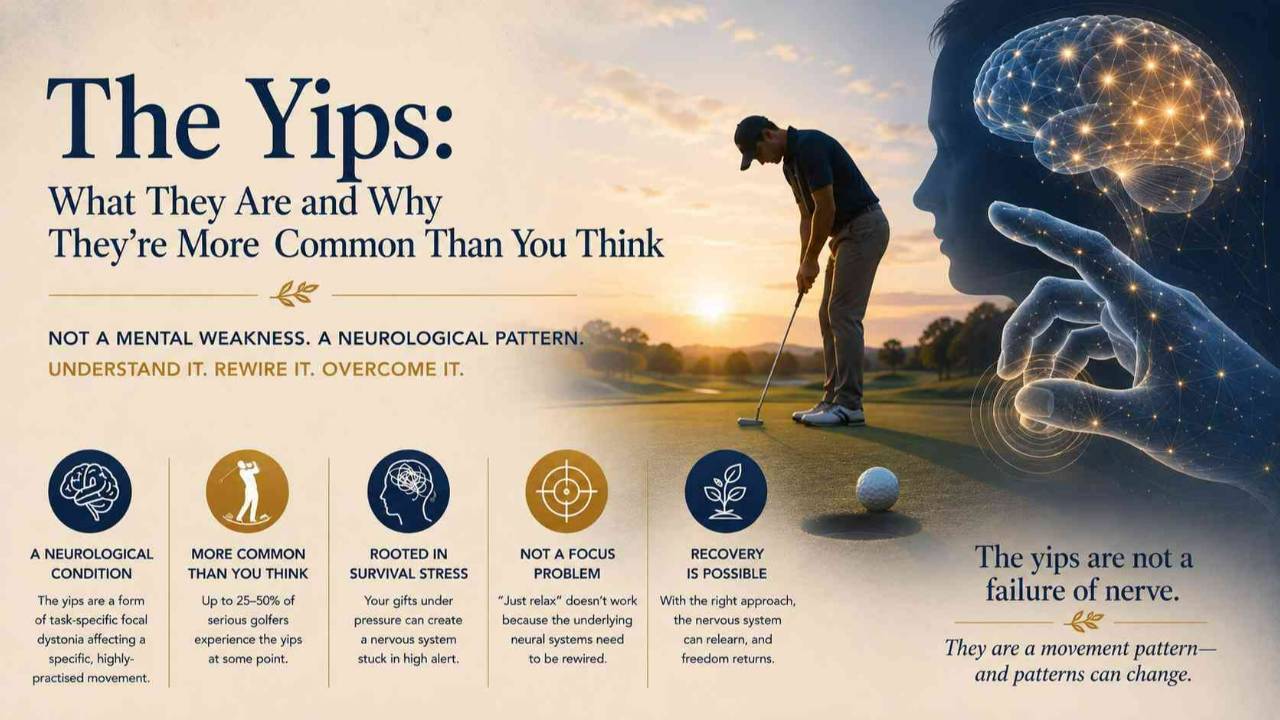
The Yips: What They Are and Why They’re More Common Than You Think
Aug 20, 2026The movement that betrays you
Ask a golfer about the yips and you will often see something flicker across their face — because for anyone who has had them, the yips are not a curiosity. They are the experience of a movement you have made flawlessly a hundred thousand times suddenly refusing to obey. A putting stroke that jerks. A hand that twitches at the moment of release. A throw, a chip, or a delivery that used to be automatic and is now unpredictable, and unpredictable most cruelly when it matters most.
The yips have long been dismissed as a mental weakness — a failure of nerve, a lack of composure, “choking.” This framing has caused enormous and unnecessary suffering, because for a great many people the yips are not primarily psychological at all. They are widely recognised as a form of focal dystonia: a neurological condition affecting a specific, highly-practised movement.¹ Understanding that changes everything about how they can be approached — and whether they can be resolved.
If this sounds like you, our free guide is a good first step.
What the yips actually are
Research on the yips, particularly in golf, describes them as lying on a continuum. At one end sits performance anxiety — genuine “choking” under pressure. At the other sits task-specific focal dystonia — involuntary muscle contractions, tremor, jerks, or freezing in the fine movement of the hands and wrists.² Many affected players sit somewhere along that continuum, with a dystonic core that anxiety can then amplify. The key insight is that the movement disruption itself is often not a matter of nerve. It is the same kind of nervous system and motor phenomenon seen in a musician’s hand dystonia or a writer’s cramp — simply expressed on a fairway or a pitch instead.
Like all focal dystonias, the yips are task-specific. A golfer with the yips can usually do everything else with their hands perfectly; the disruption appears only in the particular stroke, often only in particular conditions. This specificity is exactly what marks it out as focal dystonia rather than a general loss of skill or a broad failure of confidence.
Why they are far more common than people admit
The yips are more widespread than the silence around them suggests. Studies of golfers have found that a substantial proportion — by some estimates between a quarter and a half of serious players — report having experienced the yips at some point.³ They appear in cricketers (bowlers who suddenly cannot release the ball cleanly), in darts players (“dartitis”), in archers, snooker players, and beyond. Wherever a fine, over-practised, high-pressure movement exists, the yips can appear.
They are underreported for a simple and painful reason: the shame attached to the “mental weakness” narrative. Athletes fear that admitting to the yips will be read as admitting they cannot handle pressure. Recognising the yips as a form of focal dystonia lifts that shame — and opens the door to an approach that can actually help.
The yips are not a failure of nerve.
They are a movement pattern — and patterns can change.
Why they develop: the gifts under pressure
The people who develop the yips tend to share a profile that will be familiar to anyone who has read about focal dystonia in musicians. They are often the most dedicated, most disciplined, most self-demanding competitors — people carrying real gifts. A deep sensitivity and attunement. An exacting standard. A natural Discipline and Constancy that drives relentless practice. A Resilience and Determination that refuses to quit.
When those gifts develop in high-pressure sporting cultures — where worth is tied to results, where the inner critic is treated as a training tool, where a single public failure can feel catastrophic — the nervous system adapts into a sustained survival state. Discipline becomes tense, forceful pushing. Resilience becomes gritted-teeth force that overrides the body’s signals. Sensitivity becomes hyper-vigilance to judgement. And the fine, automatic movement at the heart of the athlete’s craft — the putt, the release, the throw — is often where that accumulated survival state finally surfaces. The yips are not the truth of who you are, and they are not a fixed trait woven into your personality. They are an intelligent adaptation of a nervous system under sustained pressure.
Why “just relax” and technical fixes rarely work
Athletes with the yips are usually told to relax, to change their grip, to try a different technique, to think about something else. When these fail — as they usually do — the athlete concludes the problem is in their head and the shame deepens. But there is a neurological reason they fail. Consciously trying to control the movement recruits the brain’s executive attention network, and Posner’s research established that this network cannot function fully without a well-developed orienting network beneath it — the system concerned with the body’s relationship to gravity and space.⁴ In a nervous system held in survival, that orienting foundation is disrupted, which is precisely why effortful conscious control does not restore the movement. The athlete is working the wrong layer.
Our Deep Dive course shows how to work with the right layer.
Recovery is possible
Because the yips are a learned pattern held in place by a survival state, they can be resolved in the same way any focal dystonia can: by guiding the nervous system back to safety, rebuilding the orienting foundation on which coordinated movement depends, and releasing the adaptations of the gifts that hold the survival state in place. The Focal Dystonia Method works at exactly this level. Ruth has worked with athletes as well as musicians, surgeons, and people from every walk of life, because the underlying condition — and the path back — is the same. What has been learned can be unlearned. The movement that betrayed you can become, once again, your own.
If you recognise yourself in this, recovery is possible. Explore the Focal Dystonia Method programme to understand the path forward.
References
- The yips as a form of task-specific focal dystonia: Adler CH, Crews D, Kahol K, et al. Are the yips a task-specific movement disorder? Sports Health. 2011;3(1):55–58.
- The continuum between focal dystonia and choking: Smith AM, Adler CH, Crews D, et al. The ‘yips’ in golf: a continuum between a focal dystonia and choking. Sports Medicine. 2003;33(1):13–31.
- Prevalence of the yips among golfers: Smith AM, Malo SA, Laskowski ER, et al. A multidisciplinary study of the ‘yips’ phenomenon in golf: an exploratory analysis. Sports Medicine. 2000;30(6):423–437.
- Attentional networks and the orienting system: Posner MI, Petersen SE. The attention system of the human brain. Annual Review of Neuroscience. 1990;13:25–42.