
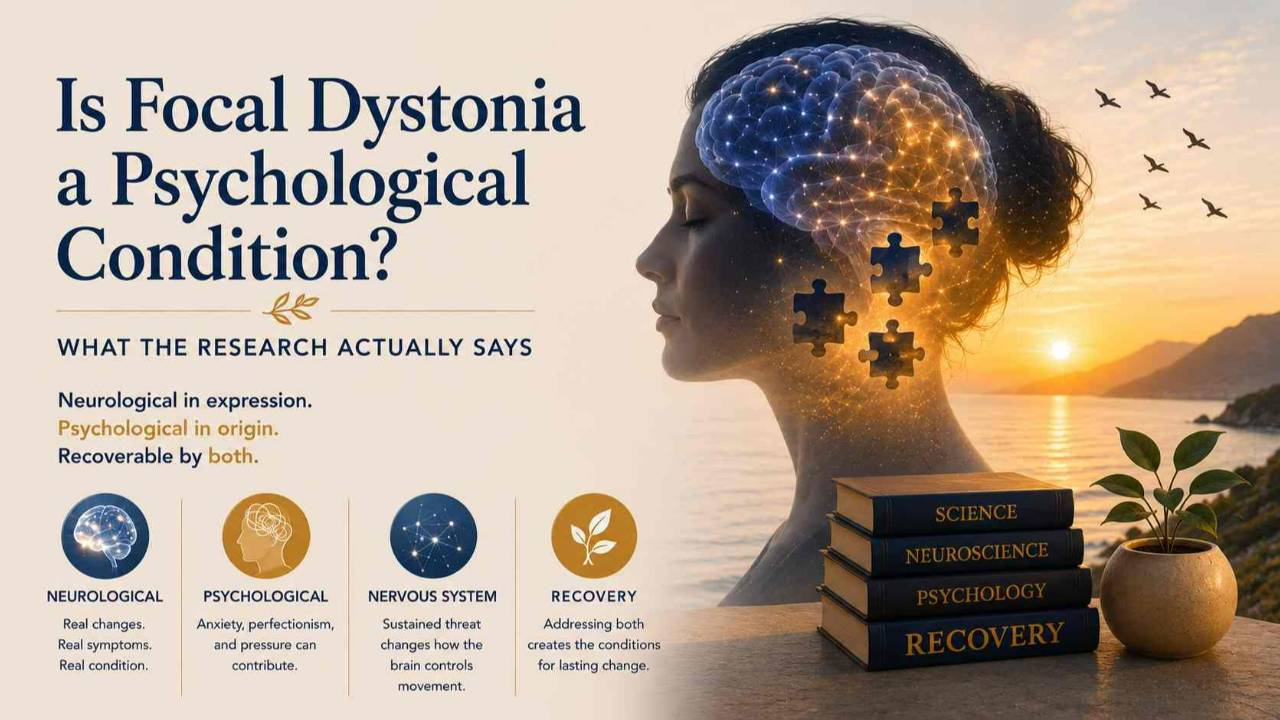
Is Focal Dystonia a Psychological Condition? What the Research Actually Says
Aug 13, 2026"When my movement first started to fail, more than one person suggested it might be 'in my head' — that it was anxiety, or nerves, or that I was somehow doing this to myself. That was hard to hear, because the difficulty is real; I can feel it, and it doesn't care whether I'm calm or not. And yet, if I'm honest, a quieter part of me wonders whether they might have a point — whether my own anxiety, or the relentless standards I've always held myself to, somehow brought this on. So I want to know what the research actually says, without the judgement on either side: is focal dystonia a psychological condition, or isn't it?"
The short answer
Focal dystonia is a neurological condition. But the neurology does not develop in isolation — and the research makes that increasingly clear.
The research base is largest in musicians, where the numbers are striking: musicians with dystonia are six times more likely to exhibit elevated anxiety, perfectionism, and stress than healthy musicians (Ioannou & Altenmüller, 2014). Anxiety disorders — particularly social phobia — occur significantly more often in musicians with dystonia, and these patterns have typically pre-existed the onset of the dystonia itself (Altenmüller & Jabusch, 2009). Recent research has identified adverse childhood experiences as a significant risk factor, with functional connectivity studies finding associations between musician’s dystonia and the neural signatures of early developmental stress (Lees et al., 2024).
The same relationship — between chronic anxiety, perfectionism, sustained pressure, and the disruption of finely trained movement — appears across the full range of people who develop focal dystonia. Musicians are the most studied group, but they are not the only people for whom this pattern holds.
This is not a fringe position. It is where the research has been moving for two decades.
New here? Our free guide is a clear, kind place to begin.
But doesn’t that mean it’s “all in the head”?
No — and this distinction matters enormously.
Saying that anxiety and perfectionism contribute to focal dystonia does not mean the condition is imagined, exaggerated, or a personality problem. It means that the nervous system, shaped by sustained psychological pressure, produces measurable neurological changes. Those changes are real. They show up in brain scans. They affect the basal ganglia, the sensorimotor cortex, the functional connectivity between motor control regions (Lees et al., 2024). The movement disorder is genuine.
What the research challenges is the idea that those changes arose in isolation from the person’s psychological history.
How does anxiety actually cause movement problems?
Altenmüller and Jabusch (2009) propose what they call emotionally induced motor memory consolidation. The idea is this: when highly trained movements are practised and performed over years in an emotional environment of threat — competition, fear of failure, perfectionism — the motor patterns become encoded alongside that emotional state. The movement and the fear become linked in the nervous system.
Over time, as the anxiety deepens and the sensorimotor system becomes more disrupted, the nervous system loses the precise inhibitory control that skilled movement requires. The result is focal dystonia — not a random neurological event, but the accumulated consequence of a system that has been operating under sustained threat for a long time.
This applies whether the movement in question is a string musician’s vibrato, a surgeon’s precision hold, a writer’s grip, or any other finely trained pattern that has been practised under pressure over years.
As Ioannou and Altenmüller (2014) put it directly: anxiety and perfectionism may promote the acceleration or even the triggering of dystonia.
Our Deep Dive course explores how this is worked with in recovery.
What about the perfectionism piece?
Perfectionism, in this context, is not about high standards. It is a specific psychological pattern: low self-efficacy, excessive self-focused attention, fear of negative evaluation, and the equation of performance quality with personal worth (Kenny, 2014).
This pattern creates a particular quality of attention during performance — one that is monitoring, self-critical, and threat-oriented rather than engaged and outward-facing. That quality of attention has direct neurological effects. It elevates arousal, increases muscle tension throughout the body, and disrupts the automaticity of trained motor patterns. The movement that should flow does not flow. The harder the person tries to control it, the more the nervous system tightens.
Anyone whose self-worth has been made fragile as a result of their environment may recognise this pattern. In musicians, the relationship between perfectionism and performance anxiety intensifies with years of experience, and is steeper in women than in men (Osborne & Kenny, 2015). It is likely that similar intensification operates across other high-stakes disciplines.
So what does recovery actually address?
Recovery from focal dystonia that takes the science seriously cannot focus only on the movement. The hand — or the embouchure, or the neck, or the eyelids, or the voice — is not the origin of the problem. It is where the problem has become visible.
Recovery that works at the level of the nervous system — addressing the anxiety, the threat encoding, the patterns of self-worth built around performance — changes the conditions that produced the dystonia. When those conditions change, the sensorimotor system has the space to reorganise. What has been learned can be unlearned. The nervous system is not fixed. It is responsive to experience.
This is the basis of the Focal Dystonia Method.
FAQ
Is focal dystonia caused by anxiety?
Anxiety and perfectionism are significant risk factors and are thought by researchers to contribute to the onset of focal dystonia — but the relationship is complex and multidirectional rather than simply causal.
Can treating anxiety cure focal dystonia?
Working with anxiety at the level of the nervous system is a central part of recovery in the Focal Dystonia Method, and many people recover fully. The relationship between psychological patterns and the movement disorder means that nervous system work is not supplementary — it is core.
Is focal dystonia a mental illness?
No. Focal dystonia is a neurological condition with documented changes in brain function and structure. The psychological dimension describes contributing factors and recovery pathways, not the nature of the condition itself.
Do all people with focal dystonia have anxiety?
Not all, but research consistently shows elevated rates of anxiety and perfectionism in people with focal dystonia compared to those without. The psychological dimension is not universal but is very common.
Why don’t doctors mention the anxiety connection?
The research establishing this link has grown significantly over the past two decades but has not yet entered mainstream clinical practice in many settings. Many clinicians are still working from earlier, primarily mechanical models of the condition.
References
Altenmüller, E., & Jabusch, H.-C. (2009). Focal hand dystonia in musicians: Phenomenology, etiology, and psychological trigger factors. ‘Journal of Hand Therapy, 22’(2), 144–155. https://doi.org/10.1016/j.jht.2008.11.007
Ioannou, C. I., & Altenmüller, E. (2014). Psychological characteristics in musician’s dystonia: A new diagnostic classification. ‘Neuropsychologia, 61,’ 80–88. https://doi.org/10.1016/j.neuropsychologia.2014.06.010
Kenny, D. T. (2014). ‘Music performance anxiety: Developmental, evolutionary, and psychodynamic perspectives.’ Preprints. https://doi.org/10.20944/preprints202601.0566.v1
Lees, A., Schroeder, J., Fuhl, J., Altenmüller, E., Schneider, S., & Joshi, S. (2024). Increased functional connectivity of motor regions and dorsolateral prefrontal cortex in musicians with focal hand dystonia. ‘BMC Neurology, 24,’ Article 106. https://doi.org/10.1186/s12883-024-03600-6
Osborne, M. S., & Kenny, D. T. (2015). The developmental features of music performance anxiety and perfectionism in school age music students. ‘Psychology of Education Review, 4’(1–2), 42–52. https://doi.org/10.1016/j.peh.2015.09.003