
Why Feeling Safe Changes Movement: Threat, the Vagus Nerve and Motor Control
Nov 05, 2026The word that sounds soft and is not
Safety is a word that can sound like an indulgence — the sort of thing offered when nothing more concrete is available. In the context of focal dystonia recovery it is nothing of the kind. It names a specific physiological state, with measurable characteristics, which determines how movement is organised.
Understanding why is worth some effort, because it explains the otherwise puzzling fact at the centre of this condition: that a person can know exactly what they want their hand to do, be entirely capable of doing it, and be unable to.
New here? Our free guide is a clear, kind place to begin.
Sign up here to receive future blogs, insights, and updates from us.
The body has two settings, and they organise movement differently
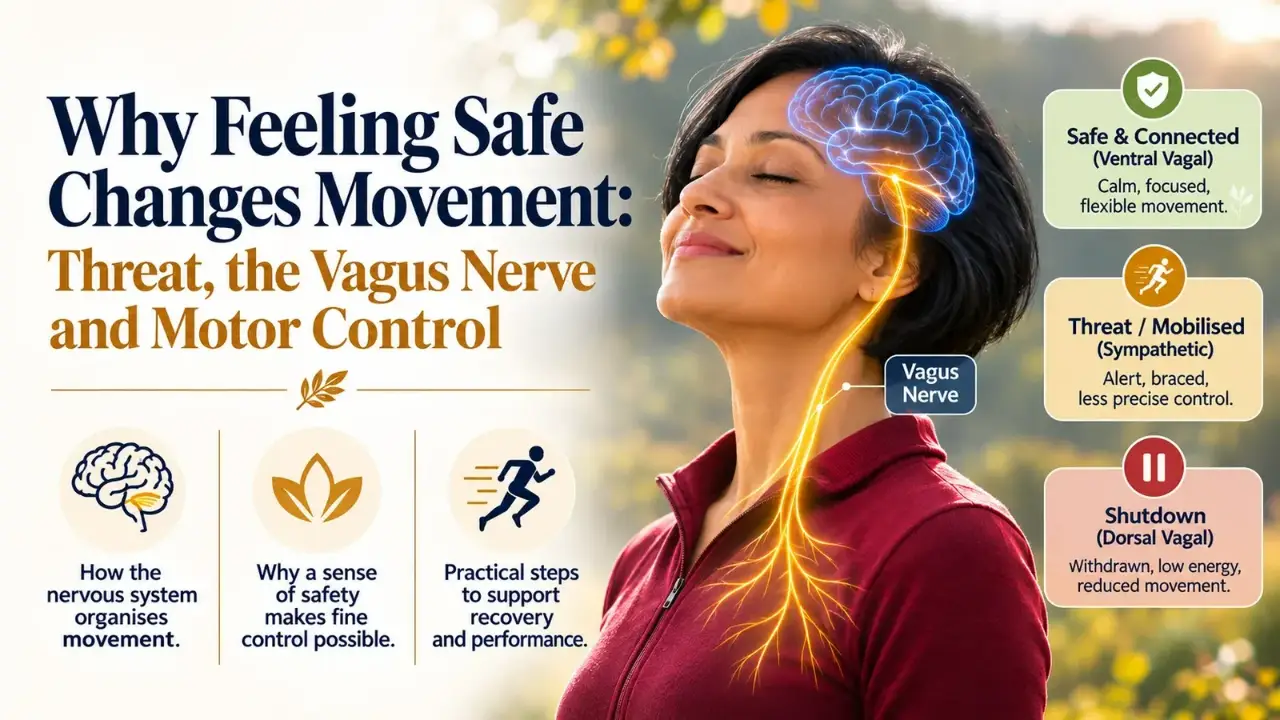
The autonomic nervous system is usually introduced as a simple switch between arousal and rest. The more useful account, developed by Stephen Porges, describes a hierarchy of states that evolved in sequence, each with its own characteristic physiology and its own behavioural repertoire.¹
At the top sits the state supported by the myelinated vagus nerve — the one associated with social engagement, with a calm heart rhythm, with an expressive face and a voice that carries nuance. Beneath it sits sympathetic mobilisation: the state of fight and flight, with its raised heart rate, its narrowed attention and its readiness for large, fast, protective action. Beneath that, the oldest response of all: shutdown.
The point that matters here is that these are not merely feelings with a physical accompaniment. Each state configures the body for a different class of behaviour — and only the first is configured for fine, exploratory, precise movement. Threat states are optimised for gross action and speed, not for the independent movement of a fourth finger.
What threat does to fine control
Consider what a nervous system does when it registers danger. Muscle tone rises. Co-contraction increases, because a braced limb is a protected limb. Attention narrows and turns towards the source of threat. Breathing shortens. The whole system is configured, sensibly, for a world in which the priority is survival rather than nuance.
Now consider what fine motor control requires: low background tone, selective activation of some muscles and active quieting of their neighbours, and unhurried attention. Almost every requirement is the opposite of the threat configuration.
There is a measured relationship here. Heart rate variability — an index of vagal regulation — tracks the brain's capacity for top-down regulation of threat responses, with consistent links to the prefrontal and amygdala circuitry involved.² A system low in that capacity is a system in which the threat configuration is more easily triggered and less easily left.
It is worth being careful about what this does and does not establish. A study of musicians with focal dystonia found that acute experimental stress did not directly worsen fine motor control — but that those who mounted a physiological stress response showed increased muscle co-contraction, and that around forty per cent had elevated anxiety, stress and perfectionism traits, developing dystonia roughly a decade earlier than the rest.³ The relationship is not a simple matter of nerves on the day. It is about the state a nervous system has been living in for years.
Why willpower cannot reach it
This is where many people come unstuck, and it is not a failure of effort.
Autonomic state is not under voluntary control. You cannot decide to be in ventral vagal safety in the way you can decide to raise your arm. What the state responds to is not instruction but cues — the felt sense of the ground, the position of the body in space, the direction of the eyes, the rhythm of the breath, the presence of another regulated person.
It is also relatively slow. A nervous system that has been in survival for twenty years does not exit it in an afternoon, and this is one of the reasons recovery from focal dystonia takes the time it does. The change is real, and it is cumulative, and it cannot be hurried by wanting it more.
Our Deep Dive course shows how this nervous-system work is done.
Interoception: the sense that has to be rebuilt
There is a further piece, and it is the one most often missing from other approaches.
To change a state, you have to be able to feel it. Interoception — the sense of the body's internal condition, carried by its own afferent pathways and represented in the insula — is the basis on which we know what is happening inside us at all.⁴ It is what allows a person to notice that their jaw has been clenched for an hour, that their breath is sitting high in the chest, that a particular passage of music produces a tightening somewhere below the sternum.
Sustained survival states tend to reduce this sense, because dissociating from a body that does not feel safe is itself protective. The consequence for a performer is that the very holding patterns driving the dystonia become invisible — felt as normal, as simply how one is, as nothing at all.
Rebuilding interoceptive awareness is therefore not preparatory work before the real work begins. It is the instrument by which everything else is done. Without it, a person cannot locate the adaptation they are trying to release, and cannot tell the difference between a state that has genuinely changed and one they have described as changed.
What this means in practice
Three consequences follow, and they shape the whole method.
The state comes before the movement. Attempting to retrain a dystonic movement in a body still in survival is asking the nervous system to produce fine control in a configuration that does not permit it — one in which the selective inhibition that skilled movement depends on is exactly what is compromised.⁵ This is why so much effortful retraining fails, and why it often makes things worse.
Orientation is not a preliminary. Where the body is in space, how it meets the ground, where the eyes rest — these are among the most direct cues of safety available, which is why the Focal Dystonia Method works with orientation and orientational eye positions before, and beneath, any attempt to change the movement itself. It is also what makes an outward focus of attention possible, and an outward focus is among the best-established conditions for skilled movement.⁶
Kindness is a physiological intervention. The softness, warmth and spaciousness cultivated in the Kindness State are not a pleasant attitude to bring to the work. They are the state itself — the configuration in which fine movement becomes available again.
The reframe
Focal dystonia looks like a fault in a hand, an embouchure, a neck. It is better understood as the visible edge of a nervous system that has been organised for survival for a very long time, doing exactly what such a system does when asked for precision under pressure.
Which is why safety is not the gentle part of this work. It is the mechanism.
To understand how this applies to your own recovery, explore the full programme at focaldystoniamethod.com.
If you are a therapist wanting to work with this approach, Ruth offers professional certification at ruthslchiles.com/certification.
Enjoyed this article? Sign up here to receive future blogs, insights, and updates from us.
References
Autonomic state and the organisation of behaviour: Porges SW. The polyvagal perspective. Biological Psychology. 2007;74(2):116–143.
Heart rate variability and prefrontal regulation of threat: Thayer JF, Åhs F, Fredrikson M, Sollers JJ, Wager TD. A meta-analysis of heart rate variability and neuroimaging studies: implications for heart rate variability as a marker of stress and health. Neuroscience & Biobehavioral Reviews. 2012;36(2):747–756.
Stress, co-contraction and trait anxiety in musicians with focal dystonia: Ioannou CI, Furuya S, Altenmüller E. The impact of stress on motor performance in skilled musicians suffering from focal dystonia: physiological and psychological characteristics. Neuropsychologia. 2016;85:226–236.
Interoception and the insula: Craig AD. How do you feel? Interoception: the sense of the physiological condition of the body. Nature Reviews Neuroscience. 2002;3(8):655–666.
Loss of inhibition in dystonia: Hallett M. Neurophysiology of dystonia: the role of inhibition. Neurobiology of Disease. 2011;42(2):177–184.
Attentional focus and motor learning: Wulf G. Attentional focus and motor learning: a review of 15 years. International Review of Sport and Exercise Psychology. 2013;6(1):77–104.