
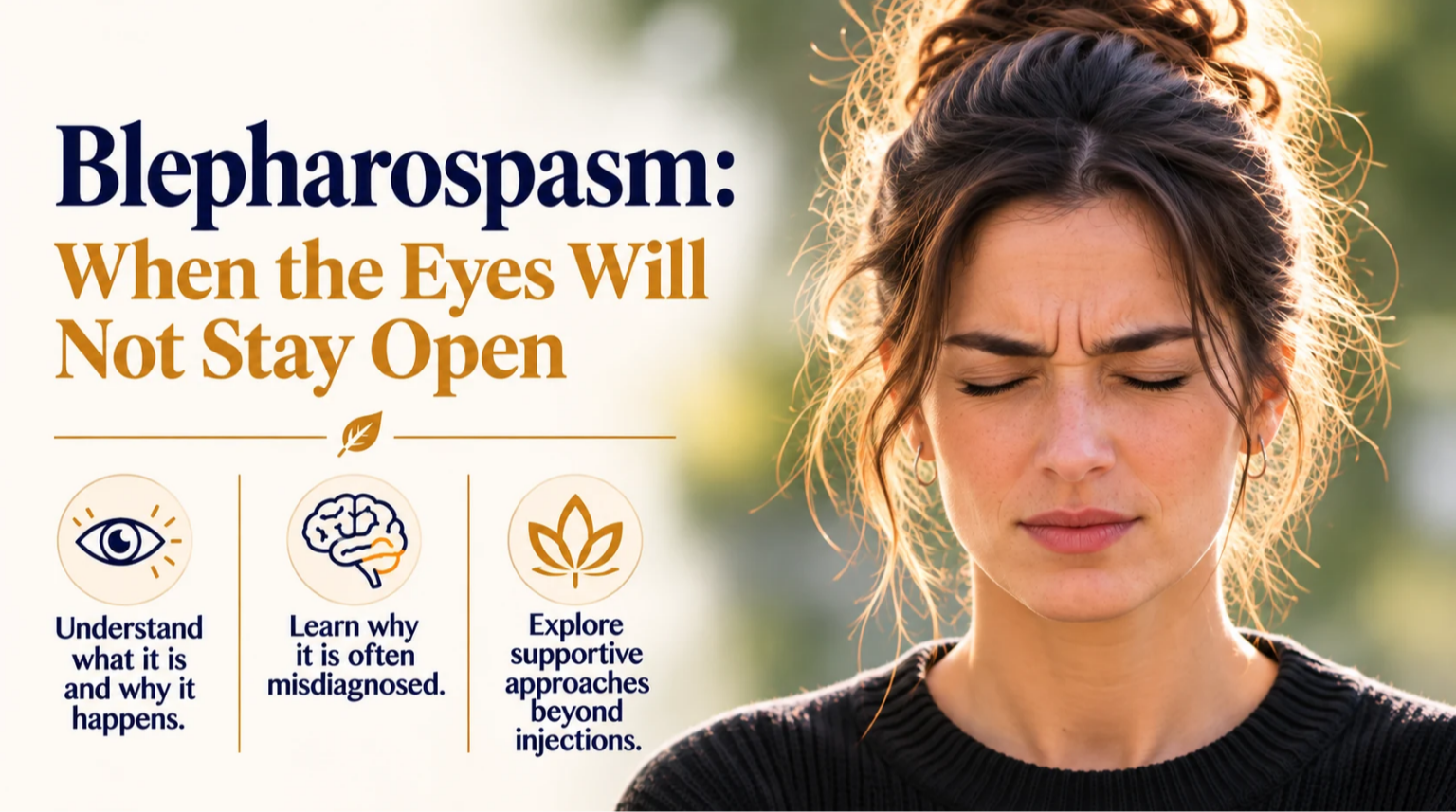
Blepharospasm: When the Eyes Will Not Stay Open
Nov 12, 2026"It started as blinking that I assumed was tiredness or dry eyes. Now there are times in the afternoon when my eyes close and I cannot open them, and I have to stand still in the street and wait. I have stopped driving. I avoid supermarkets because of the lighting. What I find hardest to explain to people is that I am not tired and I am not upset — my eyes simply will not stay open, and I have no say in it at all. Nobody has told me what this is, only what to inject."
The short answer
What you are describing is blepharospasm: a focal dystonia affecting the muscles that close the eyes. It is a recognised neurological condition, it belongs to the same family as the focal dystonias affecting the hand, the neck and the voice, and it is not caused by tiredness, emotion, or anything you have done.
It is also, by common agreement among people who live with it, one of the most functionally disabling of the focal dystonias — because a hand that will not obey is a serious loss, and eyes that will not open take away independence itself.
If you're living with this, our free guide is a gentle place to start.
Sign up here to receive future blogs, insights, and updates from us.
What is actually happening?
The orbicularis oculi — the ring of muscle that closes the eyelid — contracts involuntarily and will not release. In milder forms this appears as increased blinking; in more severe forms as prolonged closure lasting seconds or minutes, sometimes described as functional blindness, since the eyes themselves see perfectly well and simply cannot be kept open.¹
Certain features are highly characteristic. Symptoms are typically worse in bright light, in wind, in front of screens, when reading, and when driving; they are often better in the morning and worse as the day goes on; and they usually disappear entirely during sleep.² Many people also find a sensory trick — touching the brow or the corner of the eye, humming, pressing the temple — that temporarily eases the spasm. Far from being a curiosity, this is a well-documented feature of dystonia and is itself evidence that the problem is neurological rather than ocular.³
Dry, gritty or light-sensitive eyes very often precede the spasm by months or years, and the current understanding gives that observation real weight: sensitisation of the trigeminal sensory system appears to be part of the mechanism, which is why the condition so often begins as an eye complaint before it becomes a movement one.¹ ²
Why is it so often missed?
Because it arrives dressed as something else. The first port of call is almost always an optometrist or ophthalmologist, and the first explanations offered are dry eye, blepharitis, allergy or stress. Drops are prescribed. Time passes.
There is also a diagnostic pitfall specific to this condition: because it fluctuates, disappears in sleep, worsens under stress, and can be temporarily relieved by touching the face, blepharospasm has historically been misread as psychological.¹ It is not. It is a focal dystonia with documented neurophysiological abnormalities, and being told otherwise has caused a great deal of unnecessary distress to a great many people.
Our Deep Dive course explores how this is worked with in recovery.
What is usually offered — and what it does
Botulinum toxin injection into the muscles around the eye is the standard treatment and is the accepted first-line approach.¹ For many people it provides genuine relief, and nothing here is an argument against using it.
What is worth being clear about is what it does. It weakens the contracting muscle for a period of months, after which the injection is repeated. It does not address why the nervous system is generating the pattern, which is why the treatment is indefinite rather than curative. Some people find the effect diminishes over time; some find the side effects — drooping lids, double vision — hard to accept; and some simply do not wish to organise their lives around an injection schedule.
Is there anything else?
Blepharospasm is less studied from a nervous-system perspective than the musician's dystonias, and it would be wrong to claim an evidence base that does not exist. What can be said is this.
Blepharospasm shares its aetiological ground with the other adult-onset focal dystonias, and the same physiological signatures are found across the family: loss of inhibition, abnormal sensory processing, and maladaptive plasticity.⁴ ⁵ The mechanism is not, as far as anyone can tell, a different one.
It follows that the same principles apply — that a nervous system held in a state of threat and sensory sensitisation is a nervous system in which the pattern is sustained, and that changing that state changes the conditions the pattern depends on. Work with orientation, with the eyes, with interoceptive awareness and with genuine safety in the body is directly relevant to a condition expressed through the eyes.
That is offered as a reasoned extension of what is known, not as a claim of proven cure. But for people who have been told there is nothing beyond injections, it is a real and honest alternative to that conclusion.
FAQ
What is blepharospasm?
A focal dystonia in which the muscles that close the eyelids contract involuntarily, causing excessive blinking or prolonged eye closure that the person cannot control.
Is blepharospasm caused by stress?
No. It is a neurological condition, not a stress reaction, though symptoms often worsen under stress and in bright light. Being told it is psychological is a common and unfortunate misdiagnosis.
Why are my eyes worse in the afternoon?
Fluctuation through the day is characteristic, with symptoms typically milder in the morning and worse as the day continues. Symptoms usually disappear entirely during sleep.
What is a sensory trick in blepharospasm?
A touch or action — pressing the brow, humming, wearing sunglasses — that temporarily relieves the spasm. It is a recognised feature of dystonia and supports rather than undermines the diagnosis.
Is Botox the only treatment for blepharospasm?
Botulinum toxin is the accepted first-line treatment and helps many people, but it manages the symptom for a few months at a time rather than addressing the underlying pattern. Approaches working with the nervous system address different ground.
Will blepharospasm make me blind?
It does not damage the eyes or vision. In severe cases the inability to keep the eyes open causes functional blindness while the spasm lasts, which is disabling but not a loss of sight itself.
Is blepharospasm related to other dystonias?
Yes. It belongs to the same family as the adult-onset focal dystonias affecting the hand, neck and voice, and research suggests these share aetiological factors.
Enjoyed this article? Sign up here to receive future blogs, insights, and updates from us.
References
Clinical features, mechanism and treatment: Hallett M, Evinger C, Jankovic J, Stacy M. Update on blepharospasm: report from the BEBRF International Workshop. Neurology. 2008;71(16):1275–1282.
Forty-year review of blepharospasm: Defazio G, Hallett M, Jinnah HA, Conte A, Berardelli A. Blepharospasm 40 years later. Movement Disorders. 2017;32(4):498–509.
The sensory trick in dystonia: Müller J, Wissel J, Masuhr F, Ebersbach G, Wenning GK, Poewe W. Clinical characteristics of the geste antagoniste in cervical dystonia. Journal of Neurology. 2001;248(6):478–482.
Shared aetiology across adult-onset focal dystonias: Defazio G, Berardelli A, Hallett M. Do primary adult-onset focal dystonias share aetiological factors? Brain. 2007;130(Pt 5):1183–1193.
Physiological basis of dystonia: Quartarone A, Hallett M. Emerging concepts in the physiological basis of dystonia. Movement Disorders. 2013;28(7):958–967.